CARD INFORMATION
- SUBTYPES:
- Basic
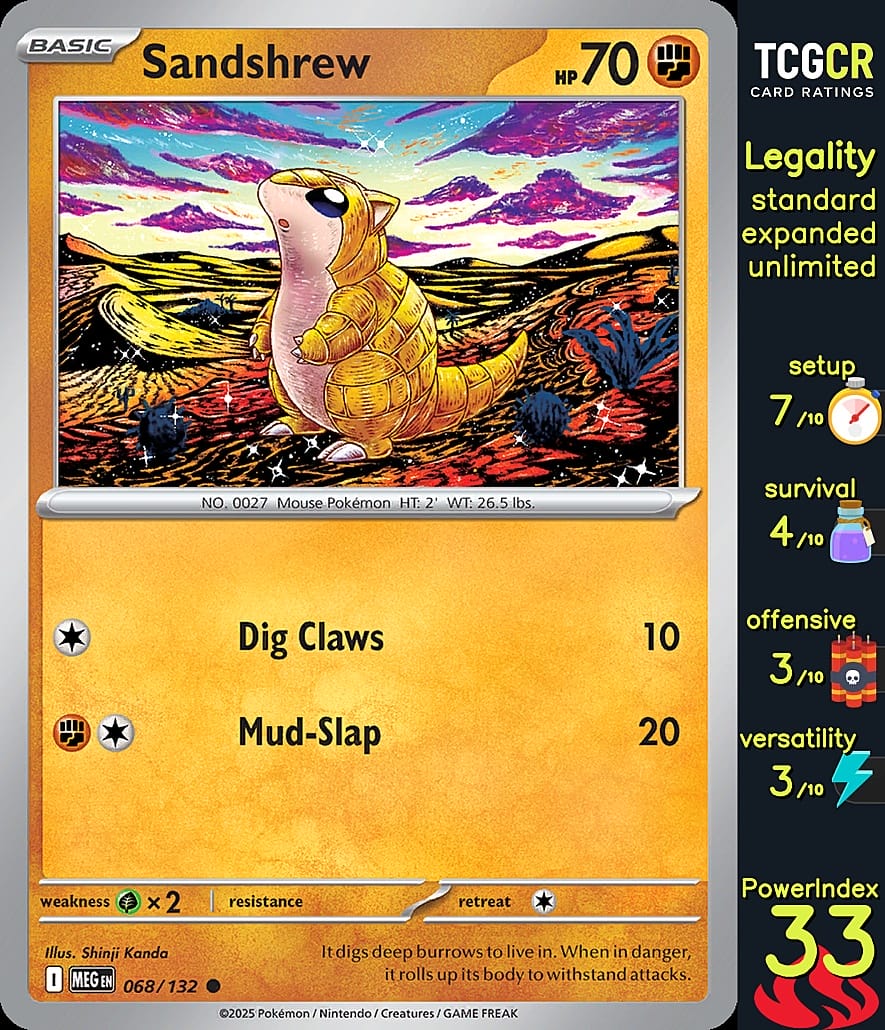
- HP: 70
- TYPES:
- Fighting
- EVOLVES TO:
- Sandslash
- WEAKNESSES:
- TYPE: Grass
- VALUE: ×2
- RETREATCOST:
- Colorless
- RETREAT COST: 1
- RARITY: Common
- REGULATIONMARK: I
CARD ABILITIES
This card has no abilitiesCARD ATTACKS
- NAME: Dig Claws
- COST:
- Colorless
- ENERGY COST: 1
- DAMAGE: 10
- DETAILS:
- NAME: Mud-Slap
- COST:
- Fighting
- Colorless
- ENERGY COST: 2
- DAMAGE: 20
- DETAILS:
MARKET PRICES FOR SANDSHREW 💰
Last updated: 2026/04/08| HIGH | 999.00 | USD | |
| MID | 0.20 | USD | TREND |
| LOW | 0.01 | USD |
Check the latest prices on:
(link)
(link)
(link)
Sandshrew emerges from the Mega Evolution set as a humble yet familiar Basic Fighting-type Pokémon.
With its distinctive yellow armor and simple attack structure, this desert dweller might seem unassuming at first glance.
But how does this Ground Mouse Pokémon truly measure up in the current TCG landscape? Let's dig beneath the surface to uncover its tournament potential.
 Offensive rating: 3/10
Sandshrew's offensive capabilities are decidedly modest.
Dig Claws offers just 10 damage for a single Colorless energy, making it one of the weaker Basic attacks in the format.
Mud-Slap fares only slightly better with 20 damage for a Fighting plus a Colorless energy.
Neither attack includes additional effects that might compensate for the low damage output.
With Fighting-type Pokémon typically expected to hit harder to counter popular Colorless and Lightning types, Sandshrew's damage-to-energy ratio feels underwhelming.
Even against Pokémon it has type advantage against, these attacks fail to threaten significant damage, positioning Sandshrew firmly as an early-game placeholder rather than a reliable attacker.
 Survival rating: 4/10
With 70 HP, Sandshrew sits at the lower end of the durability spectrum for Basic Pokémon.
While not the most fragile card on the field, it struggles to withstand even a single attack from established threats in the current meta.
Its Grass weakness is particularly problematic in formats where Grass-type attackers are present, as they can easily one-hit KO Sandshrew.
The single Colorless retreat cost is a positive aspect of its survival profile, allowing for relatively efficient pivoting if Sandshrew finds itself in a vulnerable position.
This mobility somewhat mitigates its defensive shortcomings but cannot fully compensate for its susceptibility to being knocked out before evolving.
 Versatility rating: 3/10
Versatility is where Sandshrew truly struggles to make an impact.
Its attack options offer no utility effects, status conditions, or deck manipulation abilities.
The lack of a Pokémon Ability further limits its strategic flexibility.
Sandshrew's primary value comes from being an evolution base for Sandslash, restricting its role to a developmental stepping stone rather than a versatile contributor.
The Fighting typing does provide theoretical advantage against certain archetypes featuring Normal or Electric Pokémon, but without meaningful damage output, this typing advantage remains largely theoretical.
In a meta where even Basic Pokémon often provide additional utility through abilities or attack effects, Sandshrew's one-dimensional design significantly hampers its versatility.
 Speed/Setup rating: 7/10
Sandshrew's setup speed is perhaps its strongest attribute, though this is more a reflection of its simplicity than strategic advantage.
As a Basic Pokémon, it can be played directly to the bench, requiring no previous evolution chain.
Its attacks are inexpensive, with Dig Claws being usable on the first turn with a single energy attachment.
Mud-Slap becomes operational by turn two with consistent energy attachment.
The real setup consideration involves evolving into Sandslash, making cards like Rare Candy potentially valuable partners.
While Sandshrew itself is quick to deploy, its limited immediate impact means players are typically rushing to evolve it rather than utilizing it in its Basic form.
Sandshrew functions best in decks built around its evolution, Sandslash, with supporting cards that accelerate energy attachment and evolution.
Fighting-type support cards can help compensate for its offensive limitations while waiting to evolve.
Its low retreat cost also makes it suitable for decks employing rapid switching strategies or pivot Pokémon approaches.
Perfect Partners examples:
Sandslash
As Sandshrew's evolution, this is the primary reason to include Sandshrew in any competitive deck. The potential power boost and access to stronger attacks makes the evolution essential to justify Sandshrew's inclusion.
Rare Candy
This Trainer card allows players to bypass the waiting period and evolve Sandshrew directly into Sandslash from hand, significantly accelerating the setup and reducing the time Sandshrew remains vulnerable on the field.
Fighting Energy
Essential for powering up Sandshrew's Mud-Slap attack and preparing for Sandslash's likely Fighting-type energy requirements. Consider energy acceleration cards to ensure consistent attachment each turn.
Sandshrew represents a functional but unremarkable entry point into a Fighting-type evolution line.
Its limited offensive output, moderate survivability, and lack of versatility position it firmly as a transitional card rather than a standalone contender.
In tournament play, Sandshrew should be deployed with a clear evolution strategy in mind, ideally with cards that can either protect it until evolution or accelerate directly to Sandslash.
The card performs best when minimizing its time in the active position, serving instead as a bench-sitter awaiting evolution.
Players interested in utilizing Sandshrew should focus on building a deck that mitigates its early-game vulnerabilities while capitalizing on Sandslash's presumed greater capabilities.
Despite its limitations, Sandshrew's accessibility as a Basic Pokémon does provide consistency to Fighting-type strategies dependent on its evolution line, making it a necessary inclusion for specific deck archetypes rather than a universally appealing option.
POWER INDEX
 | 33 |

 Our free website is made possible by displaying online advertisements to our visitors.