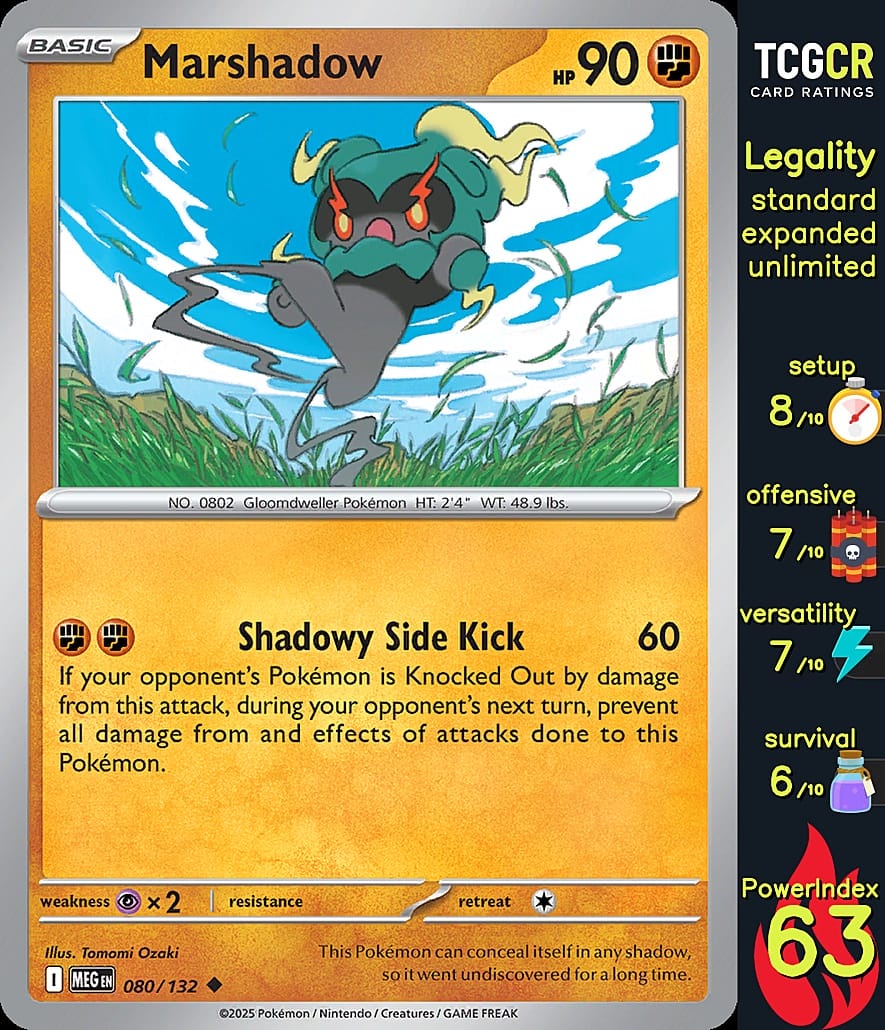
CARD INFORMATION
- SUBTYPES:
- Basic
- HP: 90
- TYPES:
- Fighting
- WEAKNESSES:
- TYPE: Psychic
- VALUE: ×2
- RETREATCOST:
- Colorless
- RETREAT COST: 1
- RARITY: Uncommon
- REGULATIONMARK: I
CARD ABILITIES
This card has no abilitiesCARD ATTACKS
- NAME: Shadowy Side Kick
- COST:
- Fighting
- Fighting
- ENERGY COST: 2
- DAMAGE: 60
- DETAILS: If your opponent's Pokémon is Knocked Out by damage from this attack, during your opponent's next turn, prevent all damage from and effects of attacks done to this Pokémon.
MARKET PRICES FOR MARSHADOW 💰
Last updated: 2026/04/08| HIGH | 999.00 | USD | |
| MID | 0.17 | USD | TREND |
| LOW | 0.01 | USD |
Check the latest prices on:
(link)
(link)
(link)
Marshadow (ME1-80) emerges as a stealthy fighter with knockout potential and a fascinating defensive mechanic.
This Fighting-type Basic Pokémon offers tournament players a unique blend of offensive power with conditional protection that can disrupt your opponent's game plan while maintaining field presence.
 Offensive rating: 7/10
With Shadowy Side Kick, Marshadow delivers a respectable 60 damage for two Fighting energy, translating to a damage-per-energy ratio of 30.
While this base output isn't overwhelming in today's high-powered meta, the true value lies in the attack's knockout effect.
When Marshadow successfully eliminates an opponent's Pokémon, it gains immunity during your opponent's next turn—essentially rewarding aggressive play with defensive benefits.
However, this conditional nature means Marshadow's offensive capability relies heavily on securing knockouts, which becomes challenging against high-HP Pokémon or resistant types.
The lack of damage modifiers or secondary effects when not securing KOs limits its consistent offensive pressure.
 Survival rating: 6/10
Marshadow's 90 HP falls below average for a Basic Pokémon in the current meta, making it vulnerable to one-hit knockouts from many popular attackers.
Its Psychic weakness further compromises survivability against increasingly common Psychic-type threats.
Where Marshadow truly shines defensively is through its Shadowy Side Kick effect—complete immunity from attacks for a turn after scoring a knockout.
This conditional protection can be game-changing when timed properly, potentially disrupting your opponent's strategy by forcing them to pivot or waste a turn.
The single retreat cost is reasonable, allowing for decent battlefield mobility.
Despite these strengths, Marshadow's survival strategy remains heavily dependent on its ability to score knockouts consistently.
 Versatility rating: 7/10
Marshadow demonstrates moderate versatility through its unique knockout-triggered immunity effect, which serves both offensive and defensive purposes.
As a Fighting type, it naturally counters Dark, Normal, and Steel Pokémon, giving it solid type coverage in many matchups.
Its Basic status means it doesn't require evolution chains, allowing for immediate deployment and energy attachment.
However, Marshadow's single-attack profile limits tactical options during play, and its effectiveness is heavily conditional on securing knockouts.
The card lacks abilities or alternative attacks that might provide utility when facing unfavorable matchups.
While it can function as both a lead attacker in certain decks or a tech card against specific threats, its overall versatility is constrained by its specialized design.
 Speed/Setup rating: 8/10
Marshadow's setup requirements are refreshingly straightforward in a format often dominated by complex evolution chains and energy-intensive attackers.
Needing just two Fighting energy for its only attack, it can become battle-ready by turn two without acceleration or by turn one with appropriate energy acceleration support.
As a Basic Pokémon, it eliminates the waiting period associated with evolutions.
The card benefits significantly from energy acceleration cards and Fighting support, helping it reach attacking potential quickly.
Its consistent energy needs make it predictable to set up, though this simplicity also means opponents can easily anticipate its strategy.
The relatively quick operational speed is partially offset by the challenge of consistently meeting its knockout condition to maximize effectiveness.
Marshadow thrives in decks that can enhance its damage output to secure more consistent knockouts and provide energy acceleration.
Strong synergies exist with Fighting-type support cards that boost damage or reduce energy requirements.
Consider pairing with damage-boosting stadiums, tools that increase attack power, or Pokémon that place damage counters to help reach knockout thresholds.
Perfect Partners examples:
Koraidon ex
As a Fighting-type heavy hitter, Koraidon ex works excellently alongside Marshadow by applying early pressure and softening targets that Marshadow can then finish off to trigger its immunity effect. Their complementary attack values create an effective damage curve.
Raging Hammer Garchomp
This powerful attacker handles bigger threats while Marshadow can clean up damaged Pokémon to activate its protection effect. Together they provide a balanced Fighting-type offense with different damage outputs for various situations.
Powerful Energy
This Special Energy adds 20 damage to your Fighting Pokémon's attacks, pushing Marshadow's damage output to 80 - a critical threshold that helps secure more knockouts and trigger its protective effect more consistently.
Marshadow occupies an interesting tactical niche in the current meta, offering a strategic risk-reward mechanic that rewards skilled timing and board awareness.
Its greatest strength lies in the immunity effect that triggers after knockouts, potentially disrupting opponent strategies by forcing them to waste turns or pivot unexpectedly.
To maximize Marshadow's effectiveness, focus on boosting its base damage through tools, stadiums, or special energy to secure more consistent knockouts.
The card performs best in Fighting-type focused decks where support Pokémon can either weaken targets for Marshadow to finish off or capitalize on the disruption caused by its immunity effect.
While not powerful enough to build an entire strategy around, Marshadow serves effectively as a complementary attacker that can create defensive pivots at crucial moments.
Players facing prevalent Psychic-type competition should be cautious about over-relying on this fighting shadow.
For tournament play, consider Marshadow as a tactical tech choice rather than a primary attacker.
POWER INDEX
 | 63 |








 Our free website is made possible by displaying online advertisements to our visitors.