CARD INFORMATION
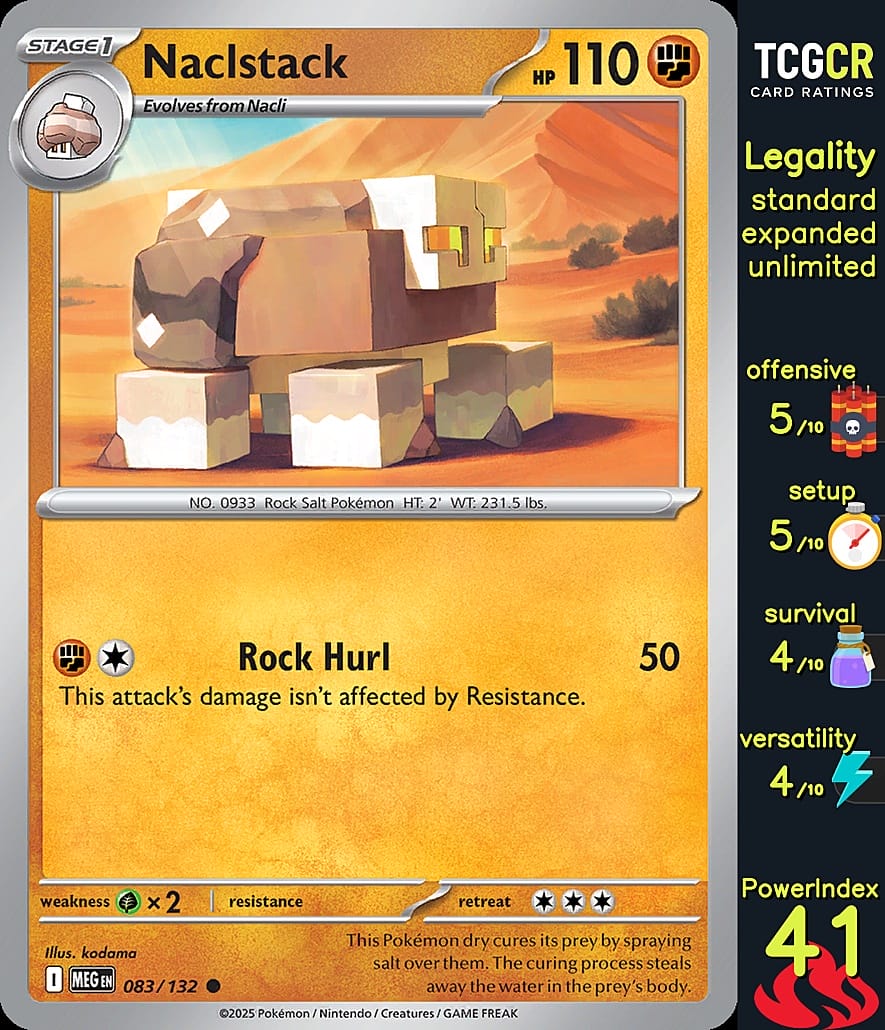
- SUBTYPES:
- Stage 1
- HP: 110
- TYPES:
- Fighting
- EVOLVES FROM: Nacli
- WEAKNESSES:
- TYPE: Grass
- VALUE: ×2
- RETREATCOST:
- Colorless
- Colorless
- Colorless
- RETREAT COST: 3
- RARITY: Common
- REGULATIONMARK: I
CARD ABILITIES
This card has no abilitiesCARD ATTACKS
- NAME: Rock Hurl
- COST:
- Fighting
- Colorless
- ENERGY COST: 2
- DAMAGE: 50
- DETAILS: This attack's damage isn't affected by Resistance.
MARKET PRICES FOR NACLSTACK 💰
Last updated: 2026/04/08| HIGH | 999.00 | USD | |
| MID | 0.17 | USD | TREND |
| LOW | 0.01 | USD |
Check the latest prices on:
(link)
(link)
(link)
Naclstack brings the power of salt to your Pokémon battles with a simple yet potentially effective Stage 1 Fighting-type card.
With 110 HP and an attack that bypasses Resistance, this evolution from Nacli offers trainers a straightforward option for their Fighting-type strategies.
Let's break down what makes this crystal formation worth considering for your next deck build.
 Offensive rating: 5/10
Naclstack's offensive capabilities center around its single attack, Rock Hurl, which deals 50 damage for two energy (one Fighting, one Colorless).
The attack's key advantage is bypassing Resistance, meaning it always deals consistent damage regardless of the opponent's type advantages.
This feature is particularly valuable against Pokémon that would normally resist Fighting attacks.
However, 50 damage for two energy is relatively modest in the current meta where many Stage 1 Pokémon can deal significantly more.
Without additional attack options or ability-based damage enhancement, Naclstack struggles to reach knockout thresholds against higher HP Pokémon without external support.
 Survival rating: 4/10
With 110 HP, Naclstack sits in the middle range for Stage 1 Pokémon, offering decent but not exceptional survivability.
Its Grass weakness is problematic in metas where Grass types are prevalent, potentially allowing opponents to score easy one-hit knockouts.
The three energy retreat cost is particularly concerning, making Naclstack extremely clunky when in the active position.
Without any defensive abilities or built-in recovery mechanisms, this salt stack can easily become trapped in the active spot, forcing you to use valuable Switch cards or other retreat support.
The combination of average HP, type weakness, and heavy retreat cost significantly limits Naclstack's staying power on the field.
 Versatility rating: 4/10
Versatility is not Naclstack's strong suit.
With a single attack and no ability, its gameplay options are extremely limited.
The Resistance-bypassing effect gives it some utility against specific matchups, but this advantage is situational rather than broadly applicable.
As a Fighting type, it can leverage type advantage against Dark, Lightning, and Metal Pokémon, providing some strategic flexibility.
However, its narrow attack options and lack of utility effects severely restrict its role diversity.
Naclstack functions primarily as a basic attacker without the versatility to adapt to different game situations or fulfill support roles, making it a one-dimensional card that can be easily predicted and countered by opponents.
 Speed/Setup rating: 5/10
As a Stage 1 Pokémon, Naclstack requires evolving from Nacli, adding an extra step in deployment compared to Basic Pokémon.
This evolution requirement slows its battlefield entry, though standard evolution support cards can mitigate this disadvantage.
The two-energy attack cost is relatively manageable, allowing it to attack by turn 2 with proper energy acceleration support.
However, the specific Fighting energy requirement adds a constraint that pure Colorless attackers don't face.
The high retreat cost further complicates its positioning strategy, requiring additional resources to maintain mobility.
While not the slowest card to set up, Naclstack lacks any built-in mechanisms to expedite its own deployment or energy attachment.
To maximize Naclstack's effectiveness, pair it with Fighting-type support and energy acceleration.
Cards that reduce retreat cost or provide switching options are essential to overcome its mobility issues.
Evolution support cards will help get Naclstack into play more consistently, while damage modifier effects can boost its modest attack power to reach meaningful knockout thresholds.
Perfect Partners examples:
Koraidon ex
As a powerful Fighting-type attacker, Koraidon ex can serve as the primary damage dealer while Naclstack handles Resistant Pokémon. Its ability to accelerate energy can also help Naclstack get powered up more quickly.
Escape Rope
This Item card helps overcome Naclstack's heavy retreat cost by forcing both players to switch their Active Pokémon, giving you mobility without paying the three energy retreat cost.
Rare Candy
Bypasses the need to play Nacli first, allowing you to evolve directly from your hand into Naclstack. This speeds up deployment considerably and improves the card's otherwise mediocre setup time.
Naclstack presents a straightforward Fighting-type option with moderate offensive potential and several notable limitations.
Its ability to ignore Resistance gives it a strategic niche, but its average damage output, hefty retreat cost, and lack of abilities or secondary effects hold it back from higher competitive viability.
The card performs best in Fighting-focused decks where it can serve as a complementary attacker against Resistant Pokémon rather than as a centerpiece.
To leverage Naclstack effectively, pair it with retreat support, energy acceleration, and damage modifiers to overcome its inherent limitations.
While not a powerhouse by any measure, its Resistance-bypassing attack does provide utility in specific matchups that could justify a spot in certain deck builds targeting particular meta environments.
POWER INDEX
 | 41 |




 Our free website is made possible by displaying online advertisements to our visitors.