CARD INFORMATION
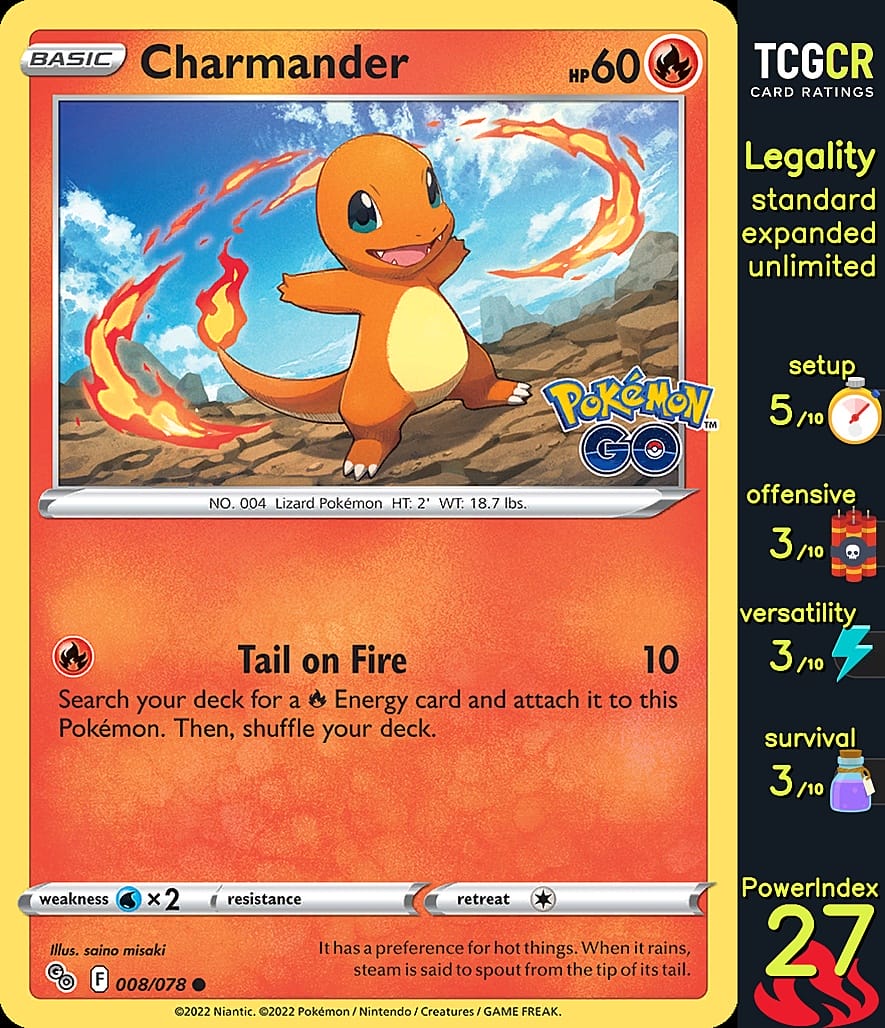
- SUBTYPES:
- Basic
- HP: 60
- TYPES:
- Fire
- EVOLVES TO:
- Charmeleon
- WEAKNESSES:
- TYPE: Water
- VALUE: ×2
- RETREATCOST:
- Colorless
- RETREAT COST: 1
- RARITY: Common
- FLAVOR TEXT: It has a preference for hot things. When it rains, steam is said to spout from the tip of its tail.
- REGULATIONMARK: F
CARD ABILITIES
This card has no abilitiesCARD ATTACKS
- NAME: Tail on Fire
- COST:
- Fire
- ENERGY COST: 1
- DAMAGE: 10
- DETAILS: Search your deck for a Fire Energy card and attach it to this Pokémon. Then, shuffle your deck.
MARKET PRICES FOR CHARMANDER 💰
Last updated: 2026/04/08| HIGH | 14.98 | USD | |
| MID | 0.22 | USD | TREND |
| LOW | 0.04 | USD |
Check the latest prices on:
(link)
(link)
(link)
Charmander from the Pokémon GO set brings a fiery start to any Fire-type strategy.
This Basic Pokémon may seem unassuming with its 60 HP, but its ability to accelerate energy attachment makes it a noteworthy foundation for evolving into its powerful forms.
Let's examine how this little fire lizard performs in the competitive landscape.
 Offensive rating: 3/10
Charmander's offensive capabilities are limited by design as a Basic Pokémon.
Its sole attack, Tail on Fire, deals a modest 10 damage for one Fire Energy, which won't threaten opponents directly.
However, the attack's true value lies in its secondary effect: searching your deck for a Fire Energy and attaching it immediately.
This energy acceleration, while attached only to itself, provides modest offensive utility by preparing for stronger attacks after evolution.
The damage-to-energy ratio is low, but the energy search effect partially compensates for this weakness, making Charmander more of a setup piece than a direct attacker.
 Survival rating: 3/10
With only 60 HP, Charmander is extremely fragile in the current metagame where even support Pokémon often have higher HP values.
Its Water weakness is a significant liability, making it vulnerable to one-hit knockouts from even the weakest Water attackers.
The single retreat cost is manageable but still requires resource investment if you need to pivot.
Charmander offers no inherent defensive abilities or damage reduction effects, leaving it completely exposed on the field.
Its survival capabilities are limited to the bare minimum for a Basic Pokémon, making it a priority target that opponents can easily remove before it evolves.
 Versatility rating: 3/10
Charmander's versatility stems primarily from its role as an evolution base rather than from its own capabilities.
The energy acceleration from Tail on Fire gives it some utility beyond being a mere stepping stone, providing modest setup support for its evolved forms.
However, its application is strictly limited to Fire-type strategies and specifically to the Charmander evolutionary line.
It doesn't function effectively as a tech card or counter to any specific archetypes.
The card's single-type energy requirement does make it somewhat flexible in terms of energy attachment, but its overall versatility remains constrained by its defined evolutionary role and typing.
 Speed/Setup rating: 5/10
Charmander's setup efficiency is where it shows its greatest strength.
Tail on Fire can be used on the first turn going second, immediately accelerating energy attachment without requiring additional cards or complex combinations.
This immediate accessibility makes it reasonably fast for setting up evolved forms like Charmeleon and Charizard.
The ability to search for Fire Energy directly reduces dependency on drawing the right energy cards naturally.
However, it still requires at least two turns to evolve into Charmeleon, and the energy acceleration is self-contained rather than flexible across your board, limiting its overall setup speed compared to more versatile acceleration options.
To maximize Charmander's potential, pair it with cards that protect it until evolution, accelerate the evolution process, and capitalize on its energy acceleration.
The ideal deck will focus on quickly evolving to its stronger forms while ensuring enough Fire Energy is available to fuel its attack effect consistently.
Perfect Partners examples:
Rare Candy
Bypasses the Charmeleon stage to evolve directly into Charizard, protecting Charmander from spending vulnerable turns as a low-HP target on the field while maximizing the energy you've attached.
Scoop Up Net
Allows you to return a damaged Charmander to your hand, preserving both the Pokémon and any attached energy cards from being knocked out, extending its utility throughout the game.
Heat Fire Energy
Provides additional damage output when attached to evolved Fire Pokémon, making the energy acceleration from Tail on Fire even more valuable as your Charmander evolves into its stronger forms.
Charmander from the Pokémon GO set serves as a functional foundation for Fire-type evolution decks, offering decent energy acceleration despite modest offensive stats.
While its 60 HP and Water weakness make it vulnerable on the field, its true value emerges as part of a cohesive evolutionary strategy.
The best approach is to use Tail on Fire early to attach additional energy, then quickly evolve to its stronger forms before opponents can target this fragile starter.
In the current meta, Charmander works best in decks with protection options or acceleration tools that minimize its time as an exposed Basic Pokémon.
Though not independently powerful, when properly supported and evolved quickly, this fire lizard can ignite the foundation for more threatening Fire-type strategies that capitalize on its early energy acceleration.
POWER INDEX
 | 27 |





 Our free website is made possible by displaying online advertisements to our visitors.