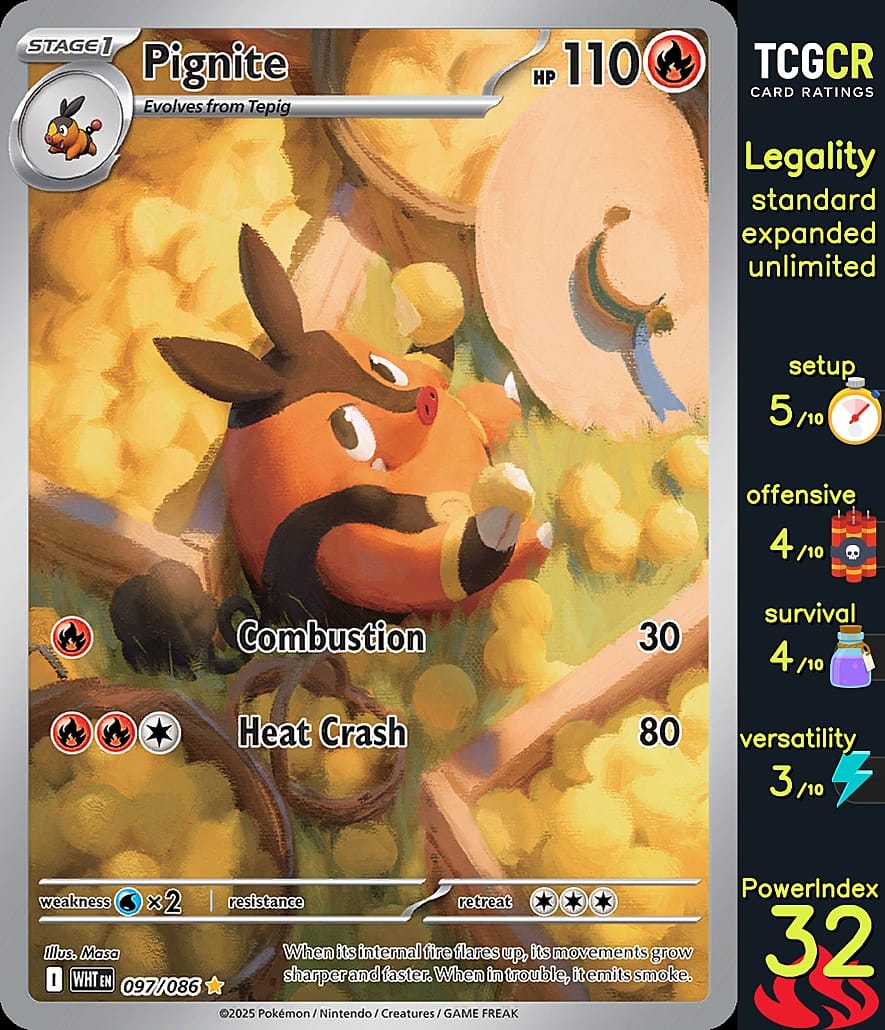
CARD INFORMATION
- SUBTYPES:
- Stage 1
- HP: 110
- TYPES:
- Fire
- EVOLVES FROM: Tepig
- EVOLVES TO:
- Emboar
- WEAKNESSES:
- TYPE: Water
- VALUE: ×2
- RETREATCOST:
- Colorless
- Colorless
- Colorless
- RETREAT COST: 3
- RARITY: Illustration Rare
- FLAVOR TEXT: When its internal fire flares up, its movements grow sharper and faster. When in trouble, it emits smoke.
- REGULATIONMARK: I
CARD ABILITIES
This card has no abilitiesCARD ATTACKS
- NAME: Combustion
- COST:
- Fire
- ENERGY COST: 1
- DAMAGE: 30
- DETAILS:
- NAME: Heat Crash
- COST:
- Fire
- Fire
- Colorless
- ENERGY COST: 3
- DAMAGE: 80
- DETAILS:
MARKET PRICES FOR PIGNITE 💰
Last updated: 2025/12/07| HIGH | 101.70 | USD | |
| MID | 6.73 | USD | TREND |
| LOW | 6.50 | USD |
Check the latest prices on:
(link)
(link)
(link)
Pignite enters the battlefield as a mid-evolution Fire-type with modest offensive capabilities.
This Stage 1 Pokémon serves as the bridge between Tepig and the powerful Emboar, but how does it stack up on its own merits? Let's analyze whether this fiery fighter has what it takes to make an impact on the competitive scene or if it's merely a stepping stone toward greater power.
 Offensive rating: 4/10
Pignite's offensive toolkit is fairly straightforward yet underwhelming by current standards.
Its Combustion attack deals 30 damage for a single Fire energy, providing a reasonable energy-to-damage ratio for early game pressure.
However, Heat Crash requires a hefty investment of three energy (two Fire and one Colorless) to deal just 80 damage with no additional effects.
This attack falls short when compared to other Stage 1 Pokémon in the current meta that can deliver more damage or provide beneficial effects for similar energy costs.
Without any damage modifiers, status effects, or ability to bypass defensive mechanics, Pignite struggles to efficiently eliminate threats or provide meaningful offensive presence.
 Survival rating: 4/10
With 110 HP, Pignite sits at a middling survival threshold for a Stage 1 Pokémon.
While this allows it to potentially withstand a hit from weaker attackers, it falls prey to many popular attackers in the current format.
Its glaring Water weakness (×2) is particularly problematic in a meta where Water-type attackers are prevalent.
Adding to its defensive woes is a prohibitive three-energy retreat cost, making it an easy target for opponents to strand in the active position.
Pignite lacks any defensive abilities or effects that could mitigate damage, heal itself, or prevent it from being targeted.
Its survival capabilities are fundamentally limited, making it a liability in extended exchanges.
 Versatility rating: 3/10
Pignite suffers from a distinct lack of versatility in the current competitive landscape.
Without any ability or special attack effects, it's confined to a one-dimensional role as a basic attacker—and not a particularly efficient one.
It doesn't offer tech options against specific archetypes, utility support for teammates, or disruption capabilities against opponent strategies.
The card doesn't synergize particularly well with common Fire-type support cards beyond standard energy acceleration.
Its rigid attack structure and lack of additional mechanics mean it struggles to adapt to different matchups or fulfill multiple roles within a deck.
Pignite simply doesn't provide the flexibility top-tier decks demand in today's environment.
 Speed/Setup rating: 5/10
As a Stage 1 Pokémon, Pignite requires evolving from Tepig, adding an inherent setup cost.
This evolution line demands deck space for both Tepig and potentially Emboar cards, constraining deck-building flexibility.
Its attacks further compound setup challenges—Combustion is reasonably efficient at one energy, but Heat Crash requires three energy attachments, typically spanning multiple turns without significant acceleration support.
The high retreat cost means you'll likely need Switch cards or similar effects to maintain board mobility.
Pignite lacks any built-in mechanisms to accelerate its own development or improve consistency.
Getting this card battle-ready requires considerable resources without offering proportional returns.
To maximize Pignite's limited potential, focus on energy acceleration and evolution support.
Cards that can attach multiple Fire energy rapidly will help overcome its energy-intensive attacks.
Evolution acceleration tools can help reach Emboar faster, using Pignite as a transitional attacker only when necessary.
Protection cards to offset its vulnerability to being stranded active are also essential.
Perfect Partners examples:
Blacksmith
This Supporter card attaches two Fire energy from your discard pile to one of your Fire Pokémon, addressing Pignite's energy-hungry attacks and potentially setting up Heat Crash in a single turn.
Rare Candy
Allows you to bypass Pignite entirely by evolving Tepig directly to Emboar, which is generally the preferred strategy given Pignite's limitations in competitive play.
Switch
Crucial for overcoming Pignite's hefty three-energy retreat cost, allowing you to pivot away from disadvantageous matchups without sacrificing attached energy resources.
Pignite ultimately falls short of competitive viability as a standalone card in the current TCG landscape.
Its mediocre damage output, vulnerability to common threats, one-dimensional gameplay, and resource-intensive setup create a package that struggles to justify deck inclusion.
In most scenarios, players will aim to quickly evolve past Pignite to reach Emboar, or use Rare Candy to bypass it entirely.
If forced to rely on Pignite temporarily, focus on its more efficient Combustion attack while building toward your actual strategy.
The card might find limited utility in casual play or specific formats with restricted card pools, but tournament players should view it primarily as an evolution stepping stone rather than a tactical asset.
For players committed to Fire-type strategies, numerous alternative options exist that provide better efficiency, protection, and competitive edge.
POWER INDEX
 | 32 |

 Our free website is made possible by displaying online advertisements to our visitors.