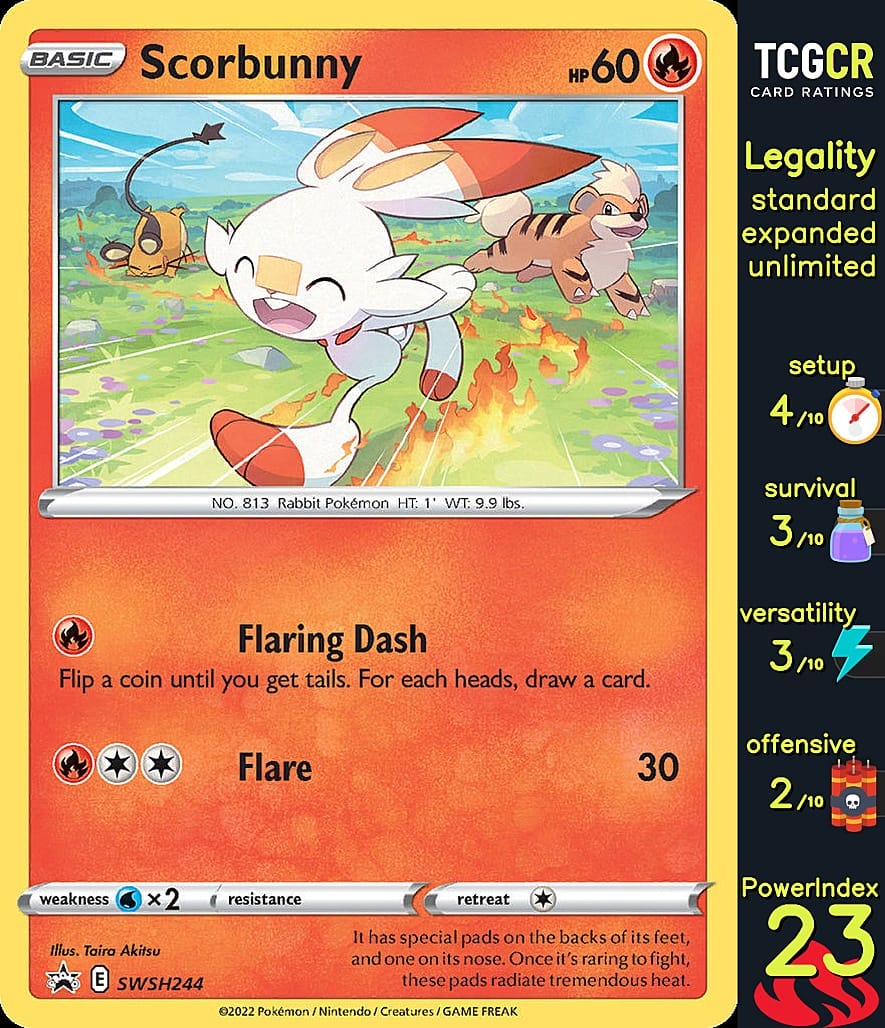
CARD INFORMATION
- SUBTYPES:
- Basic
- HP: 60
- TYPES:
- Fire
- EVOLVES TO:
- Raboot
- WEAKNESSES:
- TYPE: Water
- VALUE: ×2
- RETREATCOST:
- Colorless
- RETREAT COST: 1
- RARITY: Promo
- FLAVOR TEXT: It has special pads on the backs of its feet, and one on its nose. Once it's raring to fight, these pads radiate tremendous heat.
- REGULATIONMARK: E
CARD ABILITIES
This card has no abilitiesCARD ATTACKS
- NAME: Flaring Dash
- COST:
- Fire
- ENERGY COST: 1
- DAMAGE:
- DETAILS: Flip a coin until you get tails. For each heads, draw a card.
- NAME: Flare
- COST:
- Fire
- Colorless
- Colorless
- ENERGY COST: 3
- DAMAGE: 30
- DETAILS:
MARKET PRICES FOR SCORBUNNY 💰
Last updated: 2025/11/18| HIGH | 19.98 | USD | |
| MID | 0.42 | USD | TREND |
| LOW | 0.11 | USD |
Check the latest prices on:
(link)
(link)
(link)
Scorbunny brings a playful energy to the battlefield with its distinctive Fire-type basic setup.
As the starting evolution in the Scorbunny line, this agile Pokémon offers an interesting mix of card drawing potential and modest attacking power that tournament players need to understand to maximize its effectiveness.
 Offensive rating: 2/10
Scorbunny's offensive capabilities are rather limited when compared to many competitive Fire-type Pokémon.
Its primary attack 'Flare' delivers a modest 30 damage for a substantial investment of 3 energy (1 Fire, 2 Colorless), making its damage-per-energy ratio disappointingly low.
The lack of any bonus effects on this attack further diminishes its offensive appeal.
Its first attack, 'Flaring Dash,' doesn't deal any damage but serves as a draw engine.
While card draw is valuable, the coin flip mechanic makes it inconsistent and unreliable in tournament settings where predictability is prized.
Against the backdrop of more powerful Basic Pokémon, Scorbunny's offensive toolkit feels underpowered and inefficient, suitable primarily as a stepping stone to its evolutions rather than a standalone attacker.
 Survival rating: 3/10
With just 60 HP, Scorbunny falls on the fragile end of the spectrum for Basic Pokémon.
This modest HP pool means it can be knocked out by many common attackers with a single hit.
Its Water-type weakness (×2) further compounds this vulnerability, making it particularly susceptible in matchups against Water decks, which are common in many tournament metas.
The single Colorless retreat cost is Scorbunny's one saving grace from a survival perspective.
This low retreat requirement provides flexibility, allowing players to pivot away from unfavorable situations without significant resource investment.
However, this minor advantage doesn't compensate for its glaring durability issues.
Scorbunny is clearly designed as an evolutionary stepping stone rather than a Pokémon meant to withstand the pressures of competitive play for extended periods.
 Versatility rating: 3/10
Scorbunny offers modest versatility within specific deck archetypes.
Its primary contribution comes from 'Flaring Dash,' which can potentially draw multiple cards, adding some utility beyond just being evolution fodder.
This ability to generate card advantage gives it a secondary role as a setup supporter in the early game.
However, the coin-flip nature of this draw mechanism introduces inconsistency that tournament players find problematic.
The card lacks any additional abilities or special conditions that might increase its tactical flexibility.
Scorbunny also doesn't offer any significant tech options against popular archetypes or strategies.
Its value is primarily tied to being part of the Scorbunny-Raboot-Cinderace evolution line rather than any inherent versatility it brings to diverse deck strategies.
In formats with stronger Basic Pokémon or more efficient draw engines, Scorbunny's versatility becomes even more limited.
 Speed/Setup rating: 4/10
Scorbunny's setup requirements highlight both strengths and significant limitations.
As a Basic Pokémon, it can be played immediately to the bench, which is inherently advantageous for quick deployment.
Its 'Flaring Dash' attack requires just one Fire Energy, allowing for potential card draw on the first turn with the right opening hand.
However, to access its damage-dealing attack 'Flare,' players need to invest three energy (one Fire and two Colorless), which typically takes multiple turns without energy acceleration support.
This slow offensive development hampers Scorbunny's ability to apply early pressure.
The coin-flip mechanic on Flaring Dash introduces variability that makes setup planning difficult.
On some turns, you might draw multiple cards; on others, none at all.
Tournament players value consistency, making this randomness a significant drawback when considering Scorbunny for competitive play.
Its primary value comes from its evolution potential rather than its standalone setup efficiency.
To maximize Scorbunny's effectiveness, pair it with cards that address its key weaknesses while enhancing its strengths.
Energy acceleration cards like Welder or Heat Fire Energy are essential to power up its costly 'Flare' attack faster.
Evolution support tools such as Rare Candy can help bypass the Raboot stage to reach Cinderace more efficiently.
Cards that protect Basic Pokémon (like Mew from Unbroken Bonds) can help compensate for Scorbunny's low HP, while cards like Quick Ball and Pokémon Communication ensure you can get it into play consistently.
Consider including recovery options like Ordinary Rod to retrieve Scorbunny after knockouts.
The most competitive decks using Scorbunny will focus on rapidly evolving it while using its Flaring Dash judiciously for additional draw support when needed.
Partner Pokémon with complementary typing can help cover for Scorbunny's Water weakness while it develops toward its stronger evolved forms.
Perfect Partners examples:
Welder
This Supporter card addresses Scorbunny's biggest limitation by attaching two Fire Energy from your hand to one of your Pokémon while drawing three cards. This acceleration dramatically improves Scorbunny's setup speed, potentially enabling a first-turn 'Flare' attack and providing reliable card draw without depending on coin flips.
Rare Candy
Since Scorbunny's value largely comes from being part of an evolution line, Rare Candy serves as a critical companion by allowing you to skip the Raboot stage entirely. This speeds up access to the more powerful Cinderace cards, reducing the vulnerability window where the low-HP Scorbunny might be exposed.
Jirachi (Team Up)
Jirachi's 'Stellar Wish' Ability provides consistent card searching to find key pieces for your strategy, complementing Scorbunny's inconsistent draw power. It helps locate evolution pieces, energy cards, or tools needed to protect Scorbunny while setting up your board position reliably.
Scorbunny represents a classic case of a starter Pokémon designed primarily as an evolution stepping stone rather than a standalone competitive card.
Its modest 60 HP, Water weakness, and inefficient attacking options limit its direct impact on the battlefield.
The Flaring Dash attack offers intriguing but unreliable draw potential, while Flare demands too much energy investment for too little damage output.
In tournament play, Scorbunny's role is clearly defined: get it onto your bench, use its draw ability when advantageous, and evolve it as quickly as possible.
The single retreat cost provides welcome flexibility, but doesn't compensate for its fundamental fragility.
Players looking to incorporate the Scorbunny line into competitive decks should focus on acceleration strategies that minimize its time in the vulnerable basic form.
Energy acceleration, evolution support, and protective measures are essential companions.
Without these supporting elements, Scorbunny struggles to justify its inclusion in top-tier tournament decks.
Ultimately, your success with Scorbunny depends largely on how efficiently you can transition to its evolved forms and whether you can extract value from its Flaring Dash in the early game.
With proper deck construction and strategic planning, this fiery rabbit can serve as a useful component in specific Fire-type strategies, but it requires substantial support to overcome its inherent limitations.
POWER INDEX
 | 23 |


 Our free website is made possible by displaying online advertisements to our visitors.