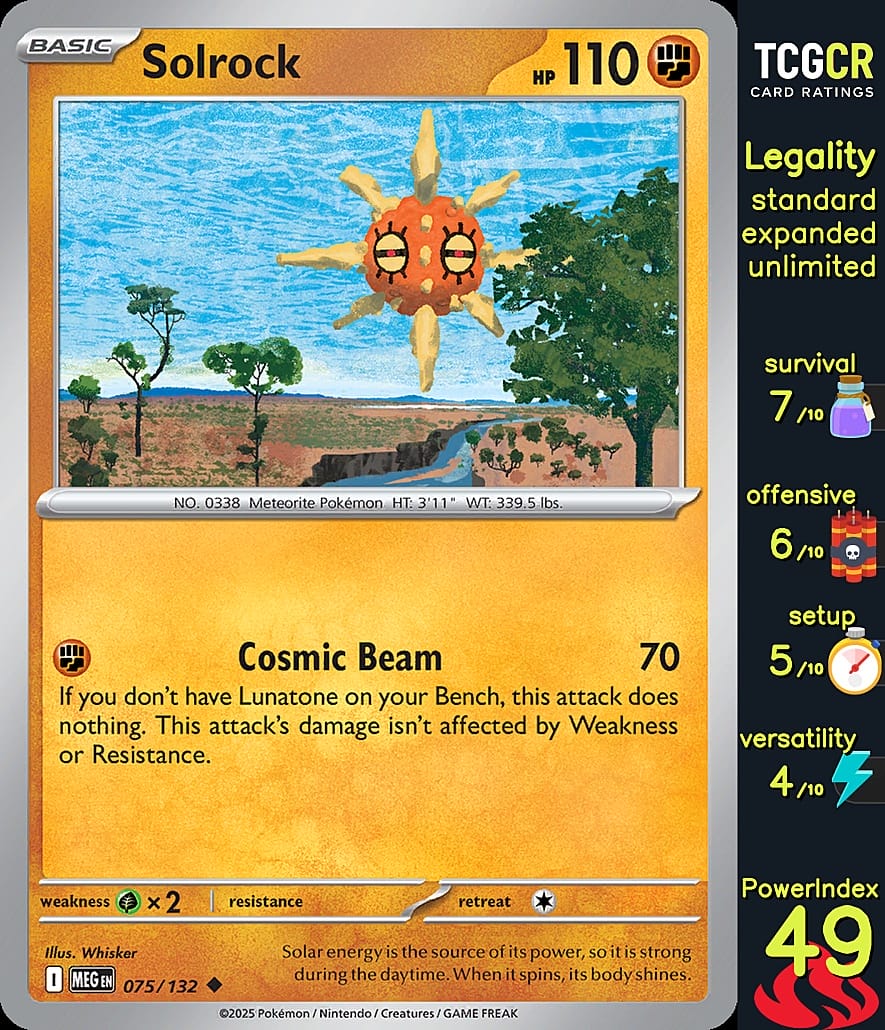
CARD INFORMATION
- SUBTYPES:
- Basic
- HP: 110
- TYPES:
- Fighting
- WEAKNESSES:
- TYPE: Grass
- VALUE: ×2
- RETREATCOST:
- Colorless
- RETREAT COST: 1
- RARITY: Uncommon
- REGULATIONMARK: I
CARD ABILITIES
This card has no abilitiesCARD ATTACKS
- NAME: Cosmic Beam
- COST:
- Fighting
- ENERGY COST: 1
- DAMAGE: 70
- DETAILS: If you don't have Lunatone on your Bench, this attack does nothing. This attack's damage isn't affected by Weakness or Resistance.
MARKET PRICES FOR SOLROCK 💰
Last updated: 2026/04/08| HIGH | 999.00 | USD | |
| MID | 0.23 | USD | TREND |
| LOW | 0.05 | USD |
Check the latest prices on:
(link)
(link)
(link)
Solrock (ME1-75) presents an interesting case of conditional power in the Pokémon TCG.
This Fighting-type Basic Pokémon relies heavily on specific board presence to function at all, making it a niche but potentially effective card when built around correctly.
With 110 HP and a single-energy attack that bypasses Weakness/Resistance, Solrock demands strategic deck construction to unlock its true potential.
 Offensive rating: 6/10
Solrock's offensive capability hinges entirely on its Cosmic Beam attack.
For just one Fighting energy, it deals 70 damage - an impressive damage-to-energy ratio that would typically score high.
However, this attack comes with a critical stipulation: it does absolutely nothing without Lunatone on your Bench.
This dependency creates a significant vulnerability in your offensive strategy.
When operational, Cosmic Beam's ability to ignore Weakness and Resistance is valuable against certain matchups, allowing consistent damage regardless of type advantages.
However, the complete reliance on another specific card limits its reliability, especially if your Lunatone gets knocked out or prized.
The conditional nature severely impacts what would otherwise be an energy-efficient offensive option.
 Survival rating: 7/10
At 110 HP, Solrock offers moderate durability for a Basic Pokémon.
This health pool positions it to potentially survive a single hit from many common attackers, though it remains vulnerable to stronger attacks or those exploiting its Grass weakness.
Its single colorless retreat cost is a significant advantage, providing flexibility to pivot away when threatened without requiring excessive resources.
However, Solrock lacks any inherent defensive abilities or effects that would enhance its survival capabilities.
The absence of damage reduction, healing, or protective abilities leaves it relying solely on its reasonable HP and low retreat cost.
Against the current meta's heavy hitters, Solrock will often find itself outmatched defensively.
 Versatility rating: 4/10
Solrock suffers considerably in the versatility department.
Its entire functionality is contingent on having Lunatone in play, creating a rigid dependency that limits its application across different deck archetypes.
This inflexibility means Solrock cannot be easily splashed into various builds as a tech card or support option.
Its single attack provides no utility effects beyond damage, further narrowing its role to a conditional attacker.
The card's Fighting typing does give it relevance against certain popular types in the meta, but this advantage is overshadowed by its restrictive playability requirements.
Essentially, Solrock is locked into a specific partnership strategy, making it useful only in decks specifically built to accommodate both cards.
 Speed/Setup rating: 5/10
Solrock's setup requirements present a significant challenge.
Beyond needing just one energy to attack (which is excellent), it absolutely requires Lunatone on your Bench to function at all.
This dual-card dependency means you must find and play both Pokémon to have any offensive capability, effectively doubling your setup complexity.
The risk of having Lunatone prized or knocked out creates additional vulnerability in your strategy.
While Solrock itself is a Basic Pokémon that can be played immediately, its operational effectiveness is tied to successfully establishing and maintaining this specific board state.
Players must dedicate resources to protecting Lunatone, as losing it instantly renders Solrock useless regardless of energy attached.
Solrock demands a deck construction approach centered around consistency and protection for its Lunatone partner.
Cards that can search for both Pokémon, recover them from the discard pile, or provide defensive support for Lunatone become essential inclusions.
Energy acceleration can help leverage Solrock's efficient attack cost, while tools that boost damage output can enhance its offensive potential beyond the base 70 damage.
Perfect Partners examples:
Lunatone
Absolutely essential as Solrock cannot attack without Lunatone on the bench. The best Lunatone variant would be one with complementary abilities or attacks that create synergy with Solrock's Fighting-type damage output.
Evolution Incense
Helps consistently find either piece of the Solrock-Lunatone combo. Ensuring you can quickly establish both Pokémon is crucial to making this strategy viable in competitive play.
Rescue Carrier
Provides insurance against your Lunatone getting knocked out, which would otherwise completely disable Solrock. The ability to recover your essential bench Pokémon maintains your offensive capability throughout the match.
Solrock presents a classic case of conditional power that requires specific deck building to unlock.
The Fighting-type Basic offers an enticing energy-to-damage ratio and immunity to Weakness/Resistance effects, but these advantages are severely undermined by its absolute dependency on having Lunatone in play.
This partnership requirement creates inherent inconsistency issues that competitive players must address through dedicated search and recovery options.
When functioning optimally, Solrock can deliver respectable damage output for minimal investment, but its vulnerability to disruption strategies targeting Lunatone creates a significant liability.
Best utilized in dedicated Solrock-Lunatone themed decks with robust consistency engines, this card performs better in casual environments where its dependency is less likely to be exploited by opponents.
Players drawn to this celestial duo should focus on maximizing bench protection and recovery options to maintain their offensive capability throughout the match.
POWER INDEX
 | 49 |
 Our free website is made possible by displaying online advertisements to our visitors.