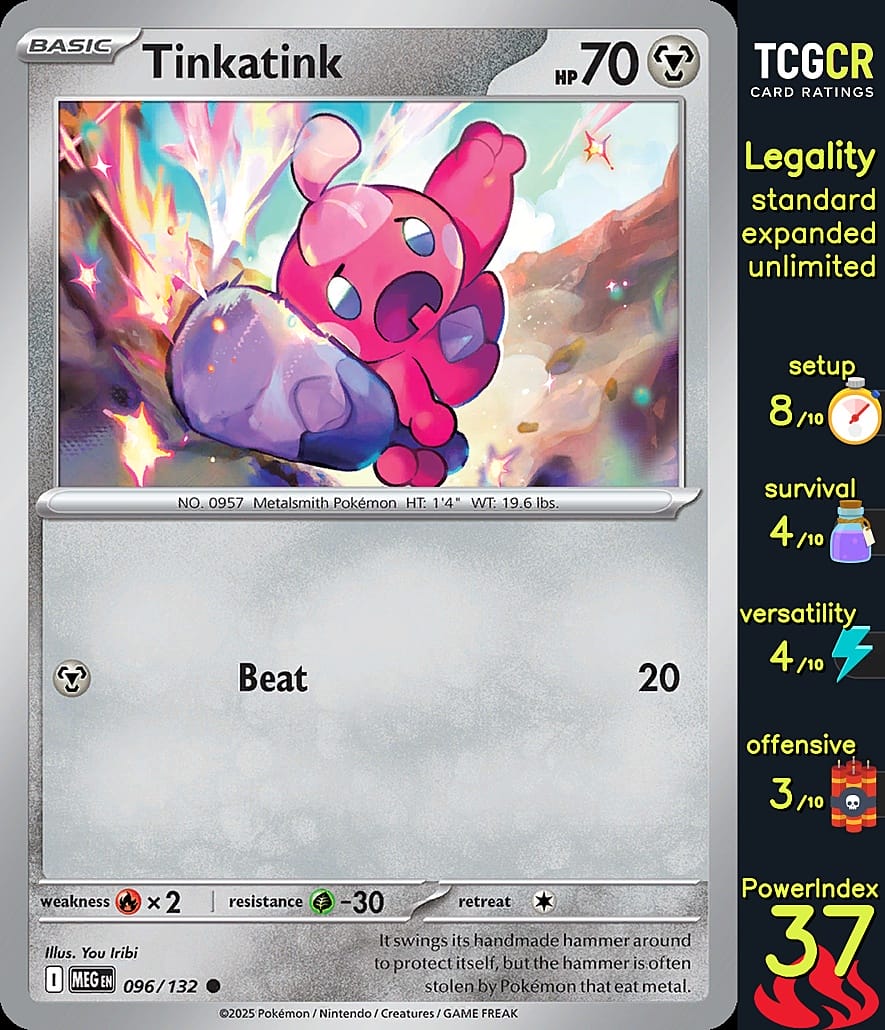
CARD INFORMATION
- SUBTYPES:
- Basic
- HP: 70
- TYPES:
- Metal
- WEAKNESSES:
- TYPE: Fire
- VALUE: ×2
- RESISTANCES:
- TYPE: Grass
- VALUE: -30
- RETREATCOST:
- Colorless
- RETREAT COST: 1
- RARITY: Common
- REGULATIONMARK: I
CARD ABILITIES
This card has no abilitiesCARD ATTACKS
- NAME: Beat
- COST:
- Metal
- ENERGY COST: 1
- DAMAGE: 20
- DETAILS:
MARKET PRICES FOR TINKATINK 💰
Last updated: 2026/04/08| HIGH | 999.00 | USD | |
| MID | 0.17 | USD | TREND |
| LOW | 0.01 | USD |
Check the latest prices on:
(link)
(link)
(link)
Tinkatink makes its TCG debut as a Basic Metal-type with modest stats but promising potential.
This fairy-forged Pokémon might seem unassuming at first glance, but its efficient energy requirements and balanced attributes make it worth examining for budget Metal decks.
Let's break down whether this tiny smith deserves a spot in your competitive lineup.
 Offensive rating: 3/10
Tinkatink offers minimal offensive capability with its single attack, Beat, dealing just 20 damage for one Metal energy.
While the energy efficiency is noteworthy, the raw damage output falls significantly short compared to other Basic Pokémon.
Without any bonus effects, secondary damage, or status conditions, Beat is purely a placeholder attack rather than a competitive option.
The lack of scaling damage or synergy with support cards further limits its offensive potential.
Tinkatink is clearly positioned as the first stage in an evolution line rather than a standalone attacker, making its offensive capabilities merely foundational rather than impactful.
 Survival rating: 4/10
With 70 HP, Tinkatink sits at the lower end of the durability spectrum for Basic Pokémon, making it vulnerable to being knocked out in a single hit by most established attackers in the current meta.
Its Fire weakness is particularly problematic in environments where Fire-type decks are prevalent.
However, Tinkatink does boast a valuable Grass resistance, reducing incoming damage by 30, which provides meaningful protection against popular Grass attackers.
The single-energy retreat cost is reasonably efficient, allowing for strategic pivoting without excessive resource commitment.
Overall, Tinkatink can survive against some Grass-type strategies but remains fragile against most competitive decks.
 Versatility rating: 4/10
Tinkatink demonstrates limited versatility as a standalone card.
Its Metal typing gives it access to Metal-specific support cards, which is beneficial in the right deck construction.
The Grass resistance provides utility against certain matchups, potentially allowing it to serve as a tech option against Grass-heavy strategies.
However, the card lacks any abilities, special effects, or multiple attack options that would allow it to fulfill different roles.
It cannot function effectively as a main attacker, wall, or support Pokémon.
Tinkatink is primarily designed as an evolution base, with its versatility almost entirely dependent on evolving into stronger forms rather than its own merits.
 Speed/Setup rating: 8/10
Tinkatink shines in its setup efficiency, requiring just one Metal energy to attack—a significant advantage in early-game scenarios.
As a Basic Pokémon, it can be played immediately without prerequisites, allowing for instant board presence.
Its low energy requirement means it can start attacking on turn one with the right support cards.
Additionally, Basic Pokémon searchers like Nest Ball, Quick Ball, and Level Ball can easily fetch Tinkatink from the deck.
The single retreat cost also contributes to its mobility and ability to pivot when needed.
While not spectacular, Tinkatink's setup speed is reasonably competitive, especially as an evolution base.
Tinkatink benefits most from being paired with its evolutions, Metal energy acceleration, and tools that boost Basic Pokémon.
Cards that protect it while gathering resources for evolution are essential, as are Metal-specific support cards that can amplify its modest damage output or provide additional utility.
Perfect Partners examples:
Tinkaton
As Tinkatinks final evolution, Tinkaton provides the payoff for developing this evolutionary line, typically featuring higher damage output and potentially game-changing abilities that justify including Tinkatink in your deck.
Metal Saucer
This Trainer card accelerates Metal energy attachment from the discard pile, allowing Tinkatink to power up its evolved forms more quickly and efficiently in subsequent turns.
Big Charm
Increasing Tinkatinks HP by 30 helps address its survivability issues, potentially allowing it to withstand an additional attack while waiting to evolve, which is crucial for its evolutionary strategy.
Tinkatink represents a balanced if unspectacular entry point to its evolution line.
Its greatest strengths lie in its quick setup potential and reasonable energy efficiency, while its primary weaknesses are its low HP and minimal offensive impact.
The card performs best as an evolution base rather than a standalone attacker, and should be evaluated primarily for how quickly it can transition to its evolved forms.
In competitive play, Tinkatink requires protective strategies and energy acceleration support to maximize its potential.
Players should focus on using it as an early-game starter while rapidly evolving to access more powerful attacks and abilities.
Budget Metal decks might find value in its accessibility and straightforward mechanics, but high-level competitive play will likely only embrace Tinkatink if its evolutions provide significant strategic advantages.
Ultimately, this card serves its purpose as the foundation of an evolution chain, with its true value determined more by what it becomes than what it is.
POWER INDEX
 | 37 |
 Our free website is made possible by displaying online advertisements to our visitors.