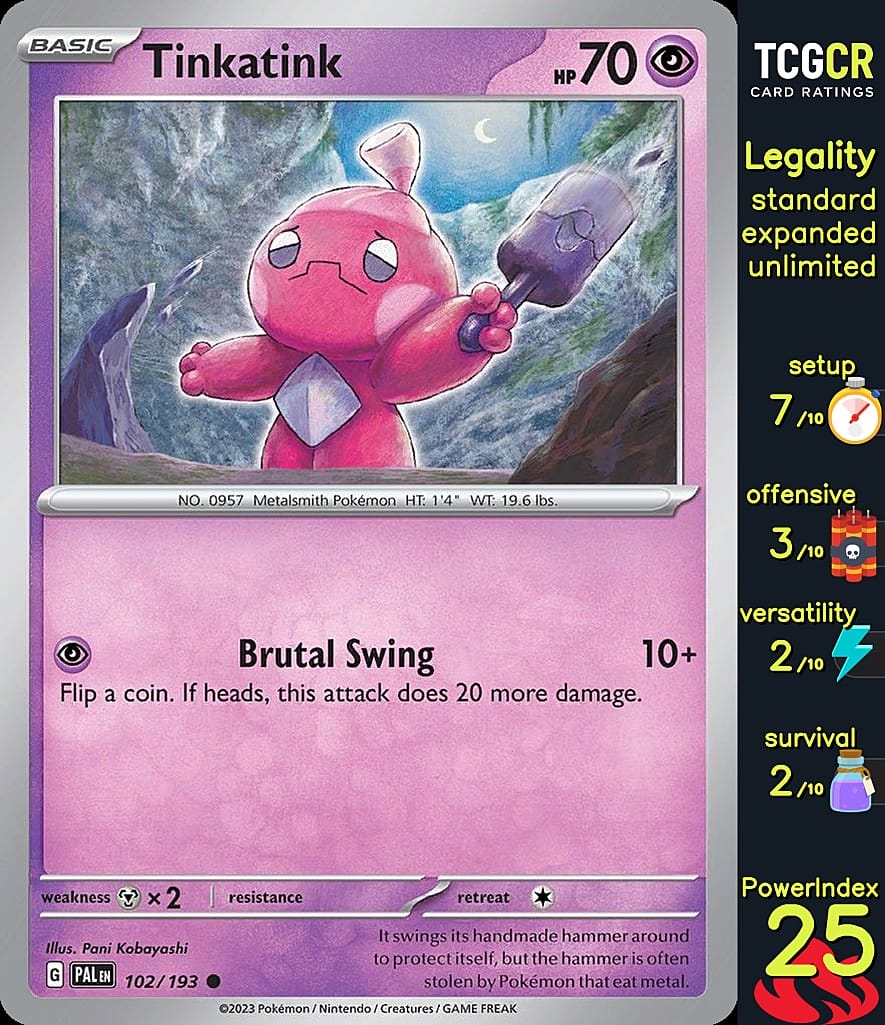
CARD INFORMATION
- SUBTYPES:
- Basic
- HP: 70
- TYPES:
- Psychic
- WEAKNESSES:
- TYPE: Metal
- VALUE: ×2
- RETREATCOST:
- Colorless
- RETREAT COST: 1
- RARITY: Common
- FLAVOR TEXT: It swings its handmade hammer around to protect itself, but the hammer is often stolen by Pokémon that eat metal.
- REGULATIONMARK: G
CARD ABILITIES
This card has no abilitiesCARD ATTACKS
- COST:
- Psychic
- NAME: Brutal Swing
- DAMAGE: 10+
- DETAILS: Flip a coin. If heads, this attack does 20 more damage.
- ENERGY COST: 1
MARKET PRICES FOR TINKATINK 💰
Last updated: 2026/01/16| HIGH | 19.99 | USD | |
| MID | 0.10 | USD | TREND |
| LOW | 0.04 | USD |
Check the latest prices on:
(link)
(link)
(link)
Tinkatink enters the battlefield as a Basic Psychic-type with modest stats but an intriguing attack mechanic.
This pint-sized Pokémon might look unassuming at first glance, but its potential coin-flip damage boost warrants a closer examination for players seeking budget-friendly options in the current meta.
 Offensive rating: 3/10
Tinkatink's offensive capabilities revolve entirely around its single attack, Brutal Swing.
For just one Psychic energy, it deals a guaranteed 10 damage with the potential to reach 30 if you're lucky with the coin flip.
While this damage output is underwhelming by modern standards, the energy efficiency is notable.
The attack's low energy requirement means Tinkatink can start attacking on your first turn, which has some merit in aggressive strategies.
However, the reliance on coin flips introduces significant inconsistency, making its damage output unreliable.
With no built-in damage modifiers or opponent-punishing effects, Tinkatink struggles to threaten even low-HP Pokémon reliably.
Against the backdrop of today's high-HP V and VMAX cards, its offensive presence feels particularly limited.
 Survival rating: 2/10
With just 70 HP, Tinkatink is extremely vulnerable in the current meta where many attackers can easily reach this damage threshold.
Its Metal weakness is particularly problematic in a format where Metal-type attackers like Lucario and Zacian variants see regular play.
The single retreat cost is reasonable for a Basic Pokémon, providing some mobility flexibility, but this hardly compensates for its fragility.
Tinkatink lacks any defensive abilities or effects that might mitigate damage or prevent knockout.
It has no healing capabilities, damage reduction, or protective mechanics that more competitive cards often feature.
In practical tournament play, Tinkatink will rarely survive more than a single attack from any established attacker, making it a liability on the Active position and an easy target for opponents looking to take quick Prize cards.
 Versatility rating: 2/10
Tinkatink's versatility is severely limited by its singular purpose and basic design.
As a Psychic-type, it theoretically has favorable matchups against Fighting types, but its low damage output undermines this advantage.
The card fails to fulfill multiple roles effectively - it's too weak to be a main attacker, lacks support abilities to function as a bench sitter, and doesn't offer any utility effects that would justify it as a tech card.
Its Basic status is its main flexibility advantage, requiring no evolution chain to deploy.
In the broader meta landscape, Tinkatink struggles to find a comfortable niche, being outclassed by numerous other Basic Pokémon with superior stats or abilities.
Without any special interactions with other cards or strategies, it remains a one-dimensional option that doesn't adapt well to different match scenarios or deck archetypes.
 Speed/Setup rating: 7/10
Tinkatink's setup speed is perhaps its strongest attribute.
As a Basic Pokémon requiring just one energy to attack, it can be operational from turn one with no additional requirements.
This immediate playability gives it a tempo advantage over evolution chains or energy-intensive attackers.
The card benefits from standard Psychic energy support like Psychic Patch or Energy Acceleration effects.
Its simplicity means fewer moving parts that could be disrupted by opponent strategies.
However, this same simplicity means there's very little to optimize - what you see is what you get.
The card doesn't grow more powerful with additional setup turns or resource investment.
In terms of consistency, the reliance on coin flips for maximum damage output introduces an element of unreliability that competitive players typically avoid.
While Tinkatink can be positioned quickly, its effectiveness ceiling remains low.
To maximize Tinkatink's limited potential, you'll want to pair it with cards that either boost its damage output or leverage its Basic Psychic-type status.
Energy acceleration partners are crucial - cards like Mew from Celebrations can help attach additional energy from your deck.
Since Tinkatink is likely serving as a temporary attacker at best, build around a stronger evolution line that can take over in the mid-game.
Lumineon V can help find key supporter cards to keep your hand refreshed while setting up stronger attackers.
Consider Radiant Greninja for its powerful ability to draw cards while simultaneously providing Water-type coverage.
For its coin-flip mechanics, cards that allow you to reflip coins like Victini (Fusion Strike) could add consistency, though dedicating deck space to support Tinkatink's modest attack may not be optimal in competitive settings.
Perfect Partners examples:
Mew (Celebrations)
Mew's Once Per Turn ability lets you search your deck for a Basic Energy card and attach it to one of your Pokémon, helping Tinkatink attack consistently while setting up more powerful attackers in your deck.
Lumineon V
Lumineon V's Luminous Sign ability when played from hand lets you search for a Supporter card, ensuring you can find crucial draw support or specific trainers needed while running a deck where Tinkatink is just an early-game placeholder.
Victini (Fusion Strike)
Victini's Victory Star ability allows you to reflip once during your turn if you get tails, significantly improving the odds of hitting the bonus damage on Tinkatink's Brutal Swing attack from 50% to 75% probability.
Tinkatink emerges as a card with limited competitive potential in the current TCG landscape.
Its greatest strengths lie in its immediate playability and energy efficiency, allowing for turn-one attacks without complex setup requirements.
However, these modest advantages are overshadowed by significant weaknesses in nearly every other category.
The combination of low HP, minimal damage output, and reliance on coin flips makes Tinkatink a risky inclusion in any serious tournament deck.
In practical terms, this card functions best as an early-game placeholder or budget option for new players still building their collection.
The opportunity cost of including Tinkatink instead of more impactful Basic Pokémon is simply too high for competitive play.
If you do choose to run it, pair it with energy acceleration and stronger attackers that can take over once Tinkatink has served its purpose.
For casual play or specifically restricted formats, its simplicity has some charm, but tournament players should look elsewhere for reliable Psychic-type options.
Tinkatink represents the baseline for Basic Pokémon rather than a card that will swing matches in your favor.
POWER INDEX
 | 25 |
 Our free website is made possible by displaying online advertisements to our visitors.