CARD INFORMATION
- SUBTYPES:
- Basic
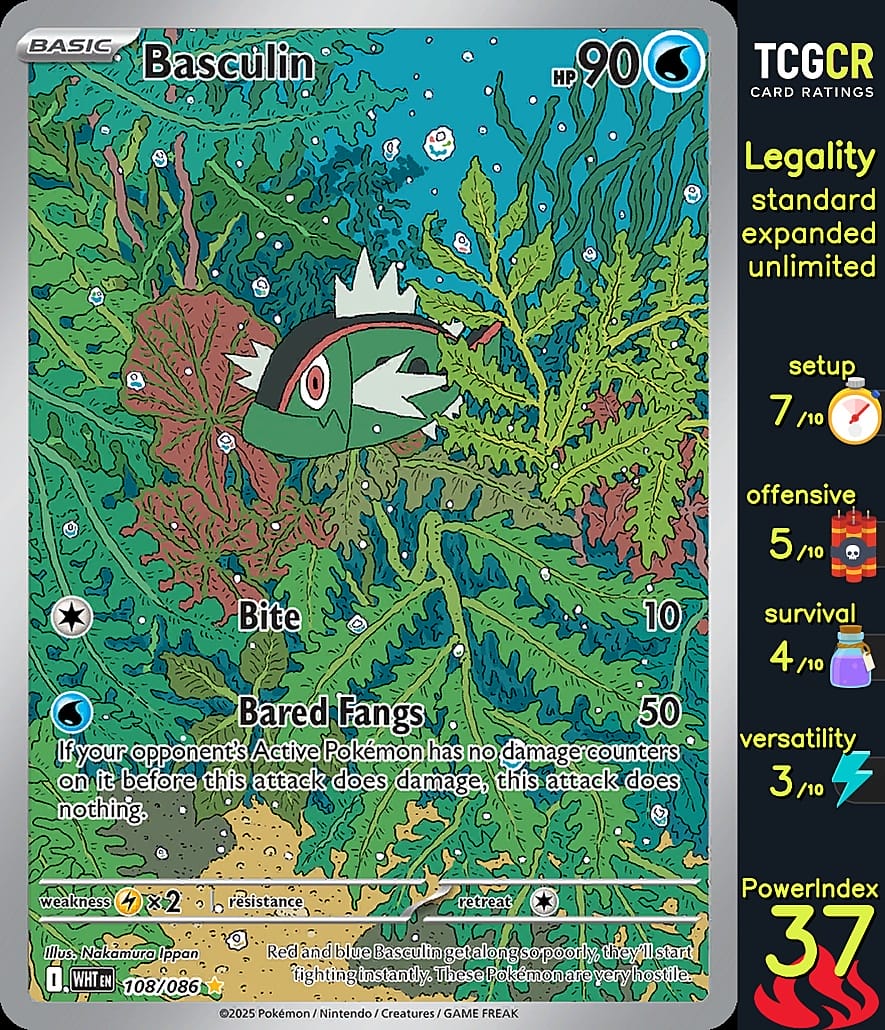
- HP: 90
- TYPES:
- Water
- WEAKNESSES:
- TYPE: Lightning
- VALUE: ×2
- RETREATCOST:
- Colorless
- RETREAT COST: 1
- RARITY: Illustration Rare
- FLAVOR TEXT: Red and blue Basculin get along so poorly, they'll start fighting instantly. These Pokémon are very hostile.
- REGULATIONMARK: I
CARD ABILITIES
This card has no abilitiesCARD ATTACKS
- NAME: Bite
- COST:
- Colorless
- ENERGY COST: 1
- DAMAGE: 10
- DETAILS:
- NAME: Bared Fangs
- COST:
- Water
- ENERGY COST: 1
- DAMAGE: 50
- DETAILS: If your opponent's Active Pokémon has no damage counters on it before this attack does damage, this attack does nothing.
MARKET PRICES FOR BASCULIN 💰
Last updated: 2025/12/12| HIGH | 60.60 | USD | |
| MID | 3.89 | USD | TREND |
| LOW | 3.44 | USD |
Check the latest prices on:
(link)
(link)
(link)
Basculin makes a splash in the competitive scene as a water-type attacker with an aggressive edge.
This hostile Pokémon brings a unique damage condition mechanic that can punish opponents who haven't yet taken damage, creating interesting strategic dynamics in tournament play.
 Offensive rating: 5/10
Basculin offers two attacking options with distinctly different purposes.
Its first attack, Bite, deals a modest 10 damage for a single Colorless energy, making it barely useful for chip damage.
The real offensive potential lies in Bared Fangs, which delivers a respectable 50 damage for just one Water energy - an excellent damage-to-energy ratio.
However, this attack comes with a significant limitation: it only works against Pokémon that already have damage counters on them.
This conditional damage output severely limits Basculins offensive capability, as it cannot initiate damage against fresh Pokémon and requires setup or partner support.
 Survival rating: 4/10
With just 90 HP, Basculin sits firmly in the vulnerable category for Basic Pokémon.
Water-types typically benefit from resistance to Fire-type attacks, but Basculin doesnt receive this defensive advantage in the current format.
Its Lightning weakness is particularly problematic in a meta where Electric-type attackers like Miraidon ex and Raikou are prevalent.
A single retreat cost is manageable, offering some mobility, but without any built-in defensive abilities or effects to mitigate damage or prevent knockouts, Basculin will struggle to survive more than one hit from most competitive attackers.
 Versatility rating: 3/10
Basculins versatility is significantly hampered by the conditional nature of its main attack.
Bared Fangs can only target Pokémon that already have damage counters, making Basculin dependent on other Pokémon to set up its attacks.
This limitation restricts its role primarily to a follow-up attacker rather than a primary offensive threat.
It lacks utility abilities that would allow it to serve alternative roles in a deck, such as drawing cards or accelerating energy.
The card also offers minimal strategic flexibility, as its single-type energy requirement and straightforward attacks dont enable complex combos or interactions with other cards in the current meta.
 Speed/Setup rating: 7/10
The setup requirements for Basculin represent both its greatest strength and weakness.
On the positive side, Bared Fangs requires just one Water energy, allowing Basculin to attack at full power on the first turn with minimal energy investment.
This speed is excellent in theory.
However, the prerequisite that the opponent must already have damage counters creates a significant tempo disadvantage.
Basculin must either wait for another Pokémon to deal damage first or rely on damage-spreading effects from other cards.
This dependency makes Basculins setup situational rather than consistent, severely limiting its reliability as a primary attacker in competitive play.
To maximize Basculins effectiveness, pair it with Pokémon or Trainer cards that can place damage counters quickly.
Cards that spread damage across multiple Pokémon or deal small amounts of chip damage will enable Basculins Bared Fangs attack immediately.
Water-type support cards can also boost its damage output beyond the base 50.
Perfect Partners examples:
Cramorant
Cramorant can place damage counters with its Spit Shot ability, setting up perfect opportunities for Basculin to follow up with Bared Fangs. This partnership creates an efficient damage sequence without requiring multiple energy attachments.
Radiant Greninja
With its Aqua Bullets ability placing 2 damage counters on Benched Pokémon, Radiant Greninja creates ideal targets for Basculin across your opponents entire field while providing Water-type synergy.
Tool Jammer
This Stadium card places a damage counter on each Pokémon with a Tool attached, potentially enabling Basculin to attack multiple Pokémon that would otherwise be untouchable with its Bared Fangs attack.
Basculin occupies a niche role in the competitive landscape, functioning primarily as a follow-up attacker in specialized Water-type strategies.
Its excellent energy efficiency is counterbalanced by the significant restriction on its main attack.
To leverage Basculin effectively, build a deck with consistent methods of placing damage counters on your opponents Pokémon.
When properly supported, it can deliver respectable damage for minimal investment.
However, its low HP, susceptibility to popular Electric types, and dependence on setup make it more suitable for budget decks or specific counter-strategies rather than tier-one competitive play.
Consider Basculin as a complementary attacker in a deck with other primary damage dealers, where it can clean up partially damaged Pokémon while conserving resources.
POWER INDEX
 | 37 |



 Our free website is made possible by displaying online advertisements to our visitors.