CARD INFORMATION
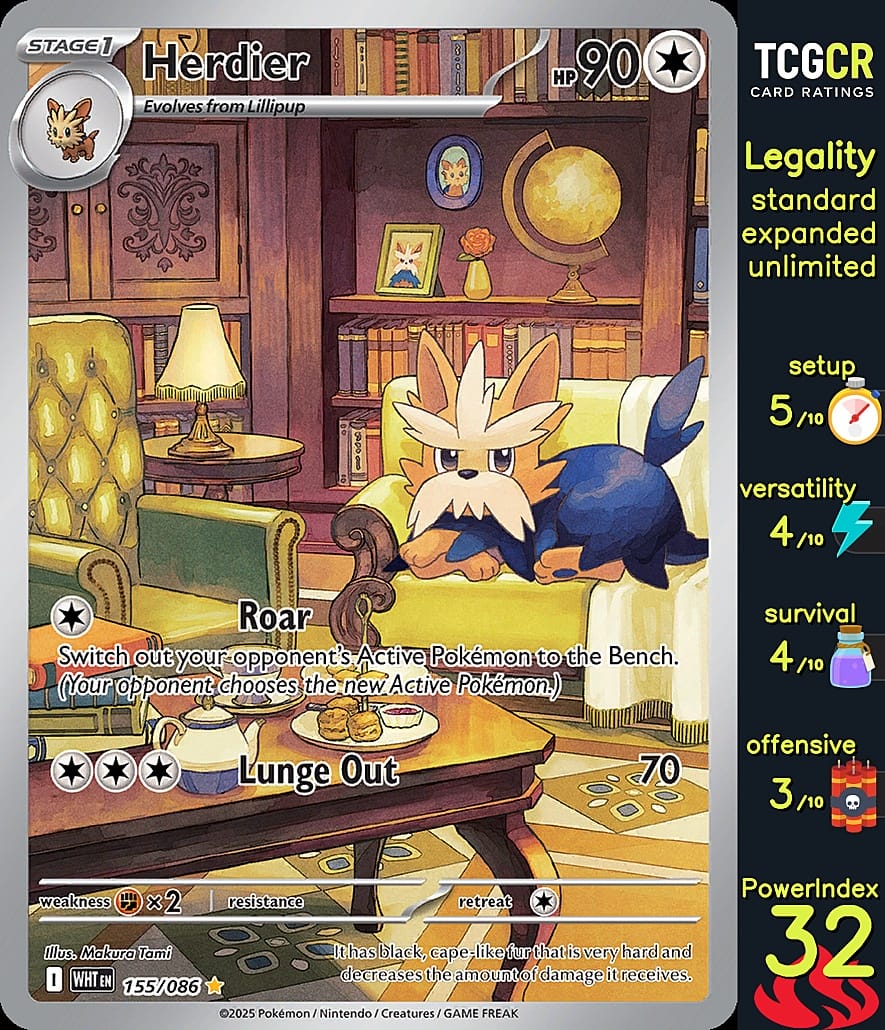
- SUBTYPES:
- Stage 1
- HP: 90
- TYPES:
- Colorless
- EVOLVES FROM: Lillipup
- EVOLVES TO:
- Stoutland
- WEAKNESSES:
- TYPE: Fighting
- VALUE: ×2
- RETREATCOST:
- Colorless
- RETREAT COST: 1
- RARITY: Illustration Rare
- FLAVOR TEXT: It has black, cape-like fur that is very hard and decreases the amount of damage it receives.
- REGULATIONMARK: I
CARD ABILITIES
This card has no abilitiesCARD ATTACKS
- NAME: Roar
- COST:
- Colorless
- ENERGY COST: 1
- DAMAGE:
- DETAILS: Switch out your opponent's Active Pokémon to the Bench. (Your opponent chooses the new Active Pokémon.)
- NAME: Lunge Out
- COST:
- Colorless
- Colorless
- Colorless
- ENERGY COST: 3
- DAMAGE: 70
- DETAILS:
MARKET PRICES FOR HERDIER 💰
Last updated: 2025/11/21| HIGH | 100.00 | USD | |
| MID | 6.62 | USD | TREND |
| LOW | 5.75 | USD |
Check the latest prices on:
(link)
(link)
(link)
Herdier enters the battlefield as a Stage 1 Colorless Pokémon that bridges the evolutionary line between Lillipup and Stoutland.
While often overlooked in favor of flashier cards, this loyal companion offers some utility with its disruptive Roar attack and straightforward Lunge Out damage output.
Let's examine whether this vigilant canine deserves a spot in your competitive deck.
 Offensive rating: 3/10
Herdier's offensive capabilities are rather limited.
Its primary attack, Lunge Out, delivers 70 damage for three Colorless energy, which translates to just 23.
3 damage per energy - an inefficient exchange rate in the current meta.
The lack of any bonus effects or damage modifiers makes this attack purely vanilla.
Its Roar attack costs just one energy but deals no damage, instead forcing your opponent to switch their Active Pokémon.
While this can disrupt setup strategies or force out a Pokémon your opponent wanted to keep safe on the bench, its utility is situational at best.
Without any ability to bypass defenses or scale damage, Herdier struggles to make a meaningful offensive impact.
 Survival rating: 4/10
With just 90 HP, Herdier sits firmly in the low-to-mid range for a Stage 1 Pokémon, making it highly susceptible to being knocked out in a single hit by many common attackers in the format.
Its Fighting weakness is particularly problematic in a meta where Fighting-type attackers are prevalent.
The single retreat cost is a small bright spot, offering reasonable mobility if Herdier gets stranded in the Active position.
However, Herdier lacks any built-in defensive abilities or effects that might enhance its survivability, such as damage reduction or healing options.
The flavor text mentions hard, damage-reducing fur, but this isn't reflected in any actual game mechanics.
 Versatility rating: 4/10
As a Colorless-type Pokémon requiring only Colorless energy, Herdier can technically fit into almost any deck composition, which provides some baseline versatility.
Its Roar attack offers utility by forcing opponent switches, which can disrupt strategies reliant on specific Active Pokémon or remove threats temporarily.
However, this effect can be easily replicated by common Trainer cards like Switch or Escape Rope, often with better strategic control.
Herdier also suffers from being an evolutionary middle-stage card with limited standalone value - players often prefer to either use the basic form for early game or skip directly to the final evolution.
Its narrow functional role as either a weak attacker or situational disruptor severely limits its versatility across different deck archetypes.
 Speed/Setup rating: 5/10
Herdier requires minimal setup from an energy perspective - one Colorless energy gets Roar online immediately, while three for Lunge Out is reasonable.
However, as a Stage 1 Pokémon, it inherently requires finding and playing both Lillipup and an evolution card, creating consistency challenges.
The evolution requirement adds an extra turn to its setup unless acceleration cards are used.
Without any abilities that work from the bench or provide value during the setup phase, Herdier offers no compensation for this evolution investment.
The card lacks any synergy with common search or recovery mechanics, making it harder to consistently incorporate into your strategy.
Its relatively slow power development curve doesn't align well with the pace of competitive play.
To maximize Herdiers limited potential, pair it with cards that can accelerate energy attachment or make its switching effects more meaningful.
Cards that punish newly-Active Pokémon or capitalize on forced switches can add strategic depth to Roar.
Evolution acceleration can help bypass the setup time, while healing support might extend its modest longevity on the field.
Perfect Partners examples:
Rare Candy
Bypasses Herdier entirely to evolve directly from Lillipup to Stoutland, which is typically more effective than playing Herdier at all unless you specifically need its Roar effect for a particular matchup.
Double Turbo Energy
Accelerates energy attachment to get Lunge Out ready in a single turn rather than multiple turns, though the energy discard effect means youll need recovery options for sustained attacks.
Gust of Wind
Works synergistically with Herdiers Roar by letting you choose which Pokémon comes Active after forcing a switch, giving you strategic control rather than leaving the choice to your opponent.
Herdier represents a functional but unremarkable stepping stone in its evolutionary line.
Its modest 90 HP, inefficient damage output, and lack of specialized abilities place it firmly below the competitive threshold for tournament play.
The Roar attack provides some utility value but is easily outclassed by Trainer cards with similar or superior effects.
In most competitive scenarios, players would be better served either using Lillipup with evolutionary support items to skip directly to Stoutland, or choosing different Pokémon entirely.
Where Herdier might find limited application is in budget decks or formats with restricted card pools.
For collectors and casual players running Stoutland-focused strategies, Herdier fills its evolutionary role adequately, but serious tournament players should look elsewhere for more impactful options that offer better returns on the card space and setup investment.
POWER INDEX
 | 32 |

 Our free website is made possible by displaying online advertisements to our visitors.