CARD INFORMATION
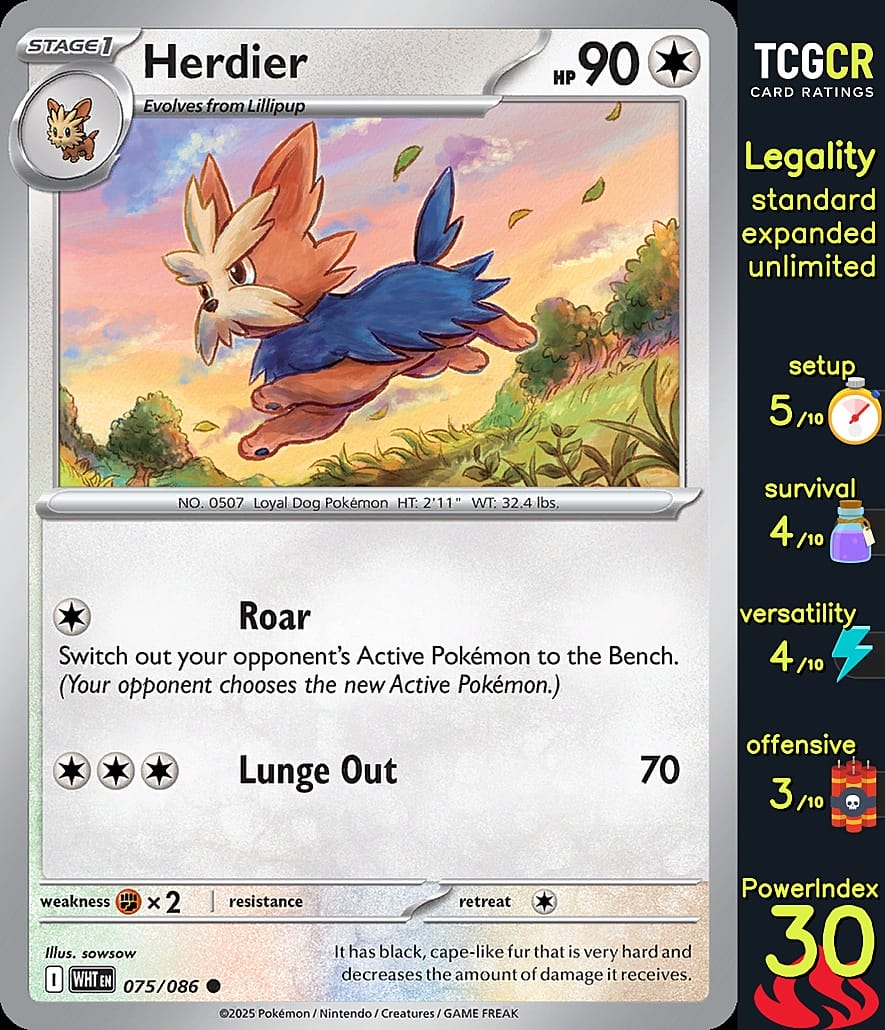
- SUBTYPES:
- Stage 1
- HP: 90
- TYPES:
- Colorless
- EVOLVES FROM: Lillipup
- EVOLVES TO:
- Stoutland
- WEAKNESSES:
- TYPE: Fighting
- VALUE: ×2
- RETREATCOST:
- Colorless
- RETREAT COST: 1
- RARITY: Common
- FLAVOR TEXT: It has black, cape-like fur that is very hard and decreases the amount of damage it receives.
- REGULATIONMARK: I
CARD ABILITIES
This card has no abilitiesCARD ATTACKS
- NAME: Roar
- COST:
- Colorless
- ENERGY COST: 1
- DAMAGE:
- DETAILS: Switch out your opponent's Active Pokémon to the Bench. (Your opponent chooses the new Active Pokémon.)
- NAME: Lunge Out
- COST:
- Colorless
- Colorless
- Colorless
- ENERGY COST: 3
- DAMAGE: 70
- DETAILS:
MARKET PRICES FOR HERDIER 💰
Last updated: 2026/01/19| HIGH | 19.98 | USD | |
| MID | 0.09 | USD | TREND |
| LOW | 0.01 | USD |
Check the latest prices on:
(link)
(link)
(link)
Herdier from White Flare set emerges as a potential utility card with its disruptive Roar attack.
This Stage 1 Colorless Pokémon might not immediately catch your eye in competitive play, but its ability to force switches deserves evaluation for players seeking tactical advantage against setup-heavy opponents.
 Offensive rating: 3/10
Herdier's offensive capabilities are limited at best.
Its primary attack, Lunge Out, requires three Colorless energy to deliver just 70 damage - an underwhelming return on investment in the current meta where many Pokémon deliver far better damage-to-energy ratios.
The Roar attack deals no damage at all, focusing instead on disruption rather than direct offense.
While forcing your opponent to switch can occasionally be strategically valuable by disrupting their setup or forcing out a vulnerable Pokémon, it lacks the raw offensive power needed to secure knockouts efficiently in competitive play.
 Survival rating: 4/10
With merely 90 HP, Herdier sits in a dangerous zone where it can be easily knocked out by most established attackers in the format.
Its Fighting weakness is particularly problematic in a meta where Fighting-type attackers are fairly common.
The card's flavor text mentions damage-reducing cape-like fur, but this doesn't translate to any actual damage reduction ability in gameplay.
The single retreat cost is a small bright spot, offering some mobility without being overly punishing.
However, this minimal advantage isn't enough to compensate for Herdier's fragility on the battlefield.
 Versatility rating: 4/10
Herdier shows limited versatility in competitive settings.
While its Roar attack can disrupt opponents by forcing a switch, this effect can be achieved through more efficient cards like Switch or Escape Rope, which don't require an attack.
The Colorless typing does offer flexibility in energy attachment, allowing any energy type to power its attacks.
However, this advantage is overshadowed by its lackluster performance in other areas.
Herdier might occasionally find niche use in very specific counter-meta strategies focused on disruption, but even then, better options typically exist for this role.
 Speed/Setup rating: 5/10
As a Stage 1 Pokémon, Herdier requires evolving from Lillipup, adding an inherent inconsistency to any strategy centered around it.
While its Roar attack needs only one energy, making it relatively quick to power up, the more impactful Lunge Out requires three energy investments - a significant commitment for such modest returns.
Modern competitive decks often prefer Pokémon that can make an immediate impact or provide consistent value.
Herdier's evolution line and energy requirements make it slower than many alternatives, limiting its viability in fast-paced tournament environments.
To maximize Herdiers limited potential, pair it with cards that can accelerate energy attachment or enhance its disruption strategy.
Consider including draw supporters and search cards to ensure consistent evolution, plus cards that can exploit the temporary advantage gained from forced switches.
Perfect Partners examples:
Double Turbo Energy
This energy card provides two Colorless energy at once, helping Herdier power up Lunge Out more quickly, albeit with a damage reduction that barely impacts its already modest output.
Raihan
This Supporter allows you to search for both an Energy card and another card when your Pokémon is knocked out, helping maintain momentum after Herdier inevitably falls in battle.
Boss's Orders
While Herdier forces a random switch, Boss's Orders gives you control over which Pokémon you target, creating a more strategic approach to disruption that complements Herdier's Roar attack.
Herdier unfortunately falls short in the competitive landscape of the current meta.
While its Roar attack offers an interesting disruption mechanic, this effect can be achieved more efficiently through Item cards.
Its offensive output is too low for its energy cost, and its survival prospects are dim given its modest HP and common weakness.
The card suffers from being neither fast enough for aggressive strategies nor impactful enough for control-oriented decks.
In casual play, Herdier might serve as part of a fun disruption strategy, particularly for newer players experimenting with forcing switches.
However, tournament players will likely pass over this loyal companion in favor of Pokémon that offer more power, better efficiency, or unique abilities that can't be easily replicated by other cards.
POWER INDEX
 | 30 |



 Our free website is made possible by displaying online advertisements to our visitors.