CARD INFORMATION
- SUBTYPES:
- Basic
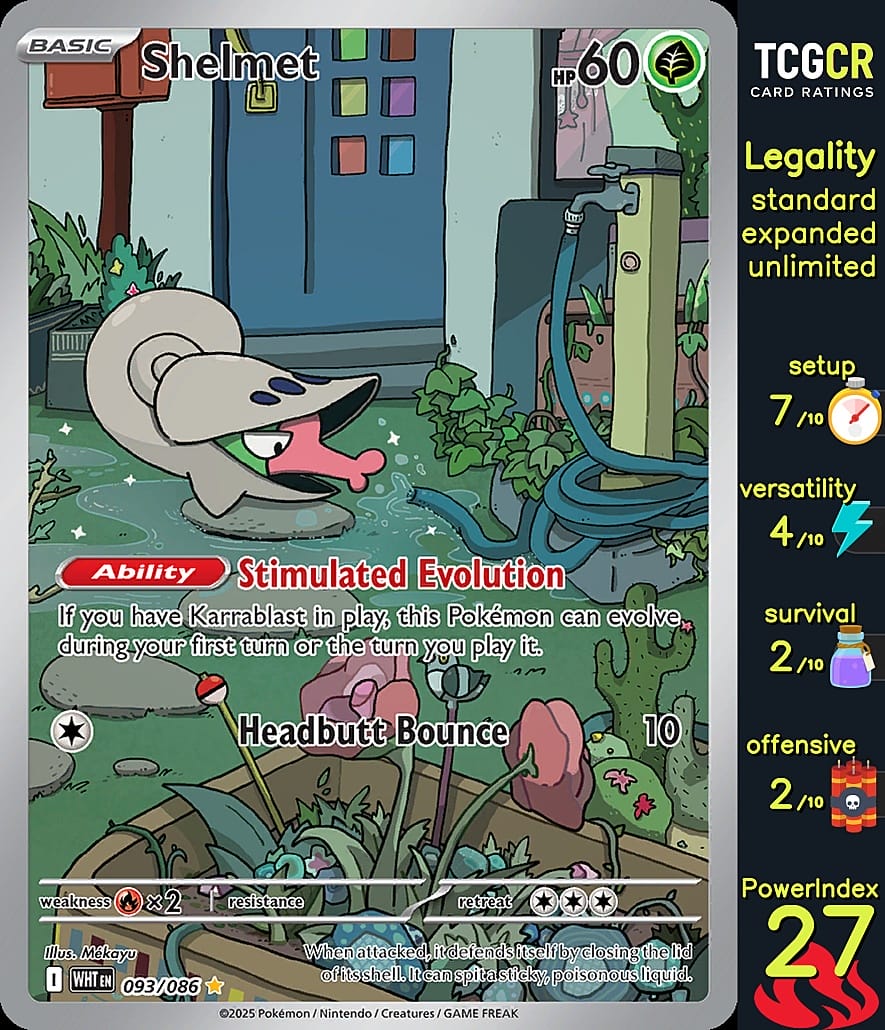
- HP: 60
- TYPES:
- Grass
- EVOLVES TO:
- Accelgor
- WEAKNESSES:
- TYPE: Fire
- VALUE: ×2
- RETREATCOST:
- Colorless
- Colorless
- Colorless
- RETREAT COST: 3
- RARITY: Illustration Rare
- FLAVOR TEXT: When attacked, it defends itself by closing the lid of its shell. It can spit a sticky, poisonous liquid.
- REGULATIONMARK: I
CARD ABILITIES
- NAME: Stimulated Evolution
- DETAILS: If you have Karrablast in play, this Pokémon can evolve during your first turn or the turn you play it.
- TYPE: Ability
CARD ATTACKS
- NAME: Headbutt Bounce
- COST:
- Colorless
- ENERGY COST: 1
- DAMAGE: 10
- DETAILS:
MARKET PRICES FOR SHELMET 💰
Last updated: 2025/12/12| HIGH | 58.00 | USD | |
| MID | 3.43 | USD | TREND |
| LOW | 3.33 | USD |
Check the latest prices on:
(link)
(link)
(link)
Shelmet brings a unique evolutionary mechanic to the table that can drastically alter your early game pace.
This Basic Grass-type Pokémon might seem unassuming at first glance, but its Stimulated Evolution ability creates interesting strategic opportunities that tournament players should not overlook, especially in specific deck builds focusing on fast evolution chains.
 Offensive rating: 2/10
Offensively, Shelmet is extremely limited.
Its single attack, Headbutt Bounce, delivers a mere 10 damage for one Colorless energy.
This attack offers virtually no competitive value in the current meta where even early game exchanges typically involve significantly higher damage output.
The attack lacks any secondary effects that might compensate for its low damage, making it functionally a placeholder rather than a viable offensive option.
Shelmet's value clearly doesn't lie in its attacking capabilities, as it's essentially incapable of applying meaningful pressure to opponents or trading favorably with any relevant Pokémon in the competitive environment.
 Survival rating: 2/10
With only 60 HP, Shelmet falls into the highly vulnerable category of Basic Pokémon.
It can be knocked out by virtually any meta-relevant attacker with minimal investment.
Its Fire weakness is particularly problematic in formats where Fire-type attackers are common.
Most concerning is its hefty three-energy retreat cost, which represents a significant resource sink if you need to pivot away from an active Shelmet.
This retreat cost is unusually high for a Basic Pokémon with such low HP, creating potential for energy stalling tactics from opponents.
Without any inherent defensive abilities to reduce damage or heal itself, Shelmet is essentially designed to evolve as quickly as possible rather than survive on its own.
 Versatility rating: 4/10
Shelmet's versatility comes almost entirely from its Stimulated Evolution ability.
This unique mechanic allows it to bypass the standard evolution rules and evolve on the first turn or the turn it's played, provided you have Karrablast in play.
This creates a niche but potentially powerful application in specialized evolution-focused strategies.
However, this versatility is heavily constrained by the requirement of having a specific Pokémon in play, making it inconsistent without proper deck building.
Outside of this specific evolutionary path, Shelmet offers little utility in terms of energy acceleration, draw support, or board control.
Its versatility is essentially one-dimensional, focused exclusively on its evolution potential.
 Speed/Setup rating: 7/10
The Speed/Setup component is where Shelmet truly shines, albeit in a very specific context.
Its Stimulated Evolution ability can provide exceptional tempo advantages by allowing first-turn evolution, circumventing one of the fundamental rules of the Pokémon TCG.
This ability to evolve immediately into Accelgor can create powerful early-game situations that opponents might not be prepared to handle.
However, this advantage comes with significant setup requirements - you must have both Shelmet and Karrablast in play simultaneously.
This dependency creates consistency issues that require dedicated deck-building solutions through search cards, draw engines, or mulligan strategies.
When the setup works, it's remarkably fast; when it doesn't, Shelmet becomes a liability.
To maximize Shelmet's potential, your deck must be built around supporting its evolution strategy while compensating for its weaknesses.
Cards that help search out both Shelmet and Karrablast are essential, alongside those that support Accelgor's strategy once evolution occurs.
Energy acceleration is also crucial to overcome Shelmet's mobility issues if it gets stuck active.
Perfect Partners examples:
Karrablast
Essential companion that enables Shelmet's Stimulated Evolution ability to function. Without Karrablast in play, Shelmet loses its primary advantage of being able to evolve on the first turn or the turn it's played.
Irida
This Supporter allows you to search for both a Water Pokémon and an Item card, helping to set up the Shelmet-Karrablast combo while grabbing useful evolution items or tools to support your strategy.
Escape Rope
Helps mitigate Shelmet's enormous retreat cost by forcing a switch, preventing it from being stranded in the active position where its minimal attack and fragile defenses would make it highly vulnerable.
Shelmet represents a highly specialized card that excels in one specific area while underperforming in most others.
Its greatest strength lies in its ability to enable rapid evolution strategies through Stimulated Evolution, potentially creating powerful early-game advantages.
However, this comes with significant conditions and constraints that limit its broad applicability.
In tournament play, Shelmet belongs exclusively in decks built to capitalize on its evolution mechanic, ideally paired with strong Accelgor cards that justify the setup investment.
Players should focus on creating consistent ways to get both Shelmet and Karrablast in play simultaneously, while having contingency plans for when Shelmet gets caught in the active position.
Ultimately, Shelmet is a tool for specific strategic approaches rather than a broadly powerful card.
Its tournament viability hinges entirely on the competitive relevance of its evolution line and your ability to build around its unique but demanding mechanics.
For the right deck architect, it offers intriguing possibilities for breaking the normal pacing constraints of evolution-based strategies.
POWER INDEX
 | 27 |




 Our free website is made possible by displaying online advertisements to our visitors.