CARD INFORMATION
- SUBTYPES:
- Basic
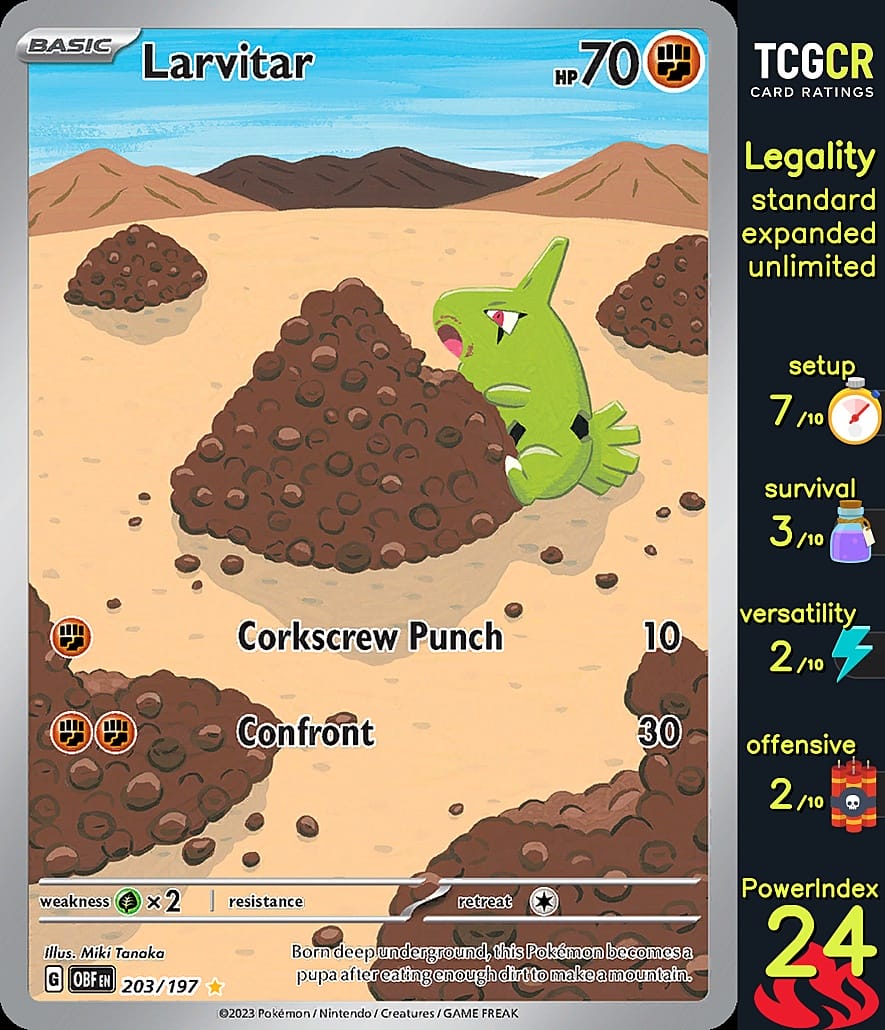
- HP: 70
- TYPES:
- Fighting
- EVOLVES TO:
- Pupitar
- WEAKNESSES:
- TYPE: Grass
- VALUE: ×2
- RETREATCOST:
- Colorless
- RETREAT COST: 1
- RARITY: Illustration Rare
- FLAVOR TEXT: Born deep underground, this Pokémon becomes a pupa after eating enough dirt to make a mountain.
- REGULATIONMARK: G
CARD ABILITIES
This card has no abilitiesCARD ATTACKS
- NAME: Corkscrew Punch
- COST:
- Fighting
- ENERGY COST: 1
- DAMAGE: 10
- DETAILS:
- NAME: Confront
- COST:
- Fighting
- Fighting
- ENERGY COST: 2
- DAMAGE: 30
- DETAILS:
MARKET PRICES FOR LARVITAR 💰
Last updated: 2025/11/18| HIGH | 107.25 | USD | |
| MID | 4.41 | USD | TREND |
| LOW | 2.45 | USD |
Check the latest prices on:
(link)
(link)
(link)
Larvitar from Obsidian Flames enters the battlefield as a Basic Fighting-type with modest 70 HP.
This small mountain-eater may seem unassuming at first glance, but is it merely a stepping stone to its evolutions, or does it have tournament potential in its own right? Let's dig deep to uncover whether this card deserves a spot in your competitive Fighting deck.
 Offensive rating: 2/10
Larvitar's offensive capabilities are remarkably limited.
Its primary attack, Corkscrew Punch, delivers a meager 10 damage for one Fighting energy - a poor damage-to-energy ratio even by Basic Pokémon standards.
Its secondary attack, Confront, offers slightly better value with 30 damage for two Fighting energy, but still fails to make a meaningful impact on the battlefield.
Without any additional effects on either attack, Larvitar can't apply pressure to opponents or threaten KOs on even the weakest Pokémon in play.
The lack of any damage modifiers or special conditions severely restricts its offensive utility in competitive play.
 Survival rating: 3/10
With just 70 HP, Larvitar sits in the lower tier of survivability among Basic Pokémon.
Its Grass weakness is particularly problematic in a meta where Grass types occasionally see play.
The single retreat cost is its only saving grace, allowing for relatively easy pivoting if needed.
However, Larvitar lacks any defensive abilities, damage reduction effects, or healing capabilities that might offset its frail constitution.
In tournament settings, it would likely fall to a single attack from most evolved Pokémon, making it highly vulnerable as an Active Pokémon.
Even against other Basic Pokémon, its staying power is minimal.
 Versatility rating: 2/10
Larvitar's versatility is severely constrained by its limited attack options and absence of abilities.
As a Basic Fighting type, it theoretically has access to Fighting support cards, but brings nothing unique to capitalize on them effectively.
Its main value lies in being an evolution base for Pupitar and eventually Tyranitar, rather than in its own capabilities.
While it can function as an early game Active Pokémon while setting up stronger attackers, it performs this role worse than many alternatives.
Its Fighting typing provides some theoretical coverage against Dark, Ice, and Normal types, but its low damage output negates this advantage.
 Speed/Setup rating: 7/10
Larvitar scores decently in the setup category purely by virtue of being a Basic Pokémon, requiring no evolution to play immediately from hand.
With only single and double Fighting energy requirements, it can attack as early as the first turn (when going second) or reliably by turn two.
The card benefits from Fighting-type support like Strong Energy and Focus Sash in expanded formats.
However, its value primarily comes from being an evolution base rather than a standalone attacker.
Cards like Ultra Ball, Quick Ball, and Level Ball can easily search it out, ensuring consistent access when building toward higher evolution stages.
Larvitar functions best as part of an evolution line leading to Tyranitar, ideally with acceleration support.
Energy acceleration cards like Turbo Patch or Raihan can help power up its evolutions faster.
Fighting-type support Pokémon such as Koraidon ex can boost its effectiveness while waiting for evolution.
Consider cards that protect Basic Pokémon or facilitate rapid evolution to maximize its potential.
Perfect Partners examples:
Tyranitar
As Larvitar's final evolution, Tyranitar provides the payoff for investing in this evolution line, typically offering powerful attacks and better survivability that justify including Larvitar in your deck.
Koraidon ex
Koraidon ex's Fighting Aura ability boosts damage from Fighting Pokémon by 20, making Larvitar's attacks slightly more viable while you work toward evolution.
Rare Candy
Allows you to skip Pupitar and evolve directly from Larvitar to Tyranitar, accelerating your setup and minimizing the time spent with the vulnerable Larvitar in play.
Larvitar from Obsidian Flames presents itself as a functional but unexciting foundation for a Fighting-type evolution line.
Its low HP, minimal damage output, and lack of special abilities or attack effects make it a liability when left in the Active position for long.
In tournament play, this card's primary purpose is serving as evolution material for potentially stronger Pupitar and Tyranitar cards, rather than as a standalone attacker.
When using Larvitar, prioritize evolving it quickly or keeping it benched until needed.
Consider pairing it with cards that can protect Basic Pokémon or accelerate evolution to minimize its vulnerability.
While not impressive on its own merits, Larvitar's true value depends entirely on the strength of the evolution chain it supports and the broader Fighting-type strategy of your deck.
POWER INDEX
 | 24 |




 Our free website is made possible by displaying online advertisements to our visitors.