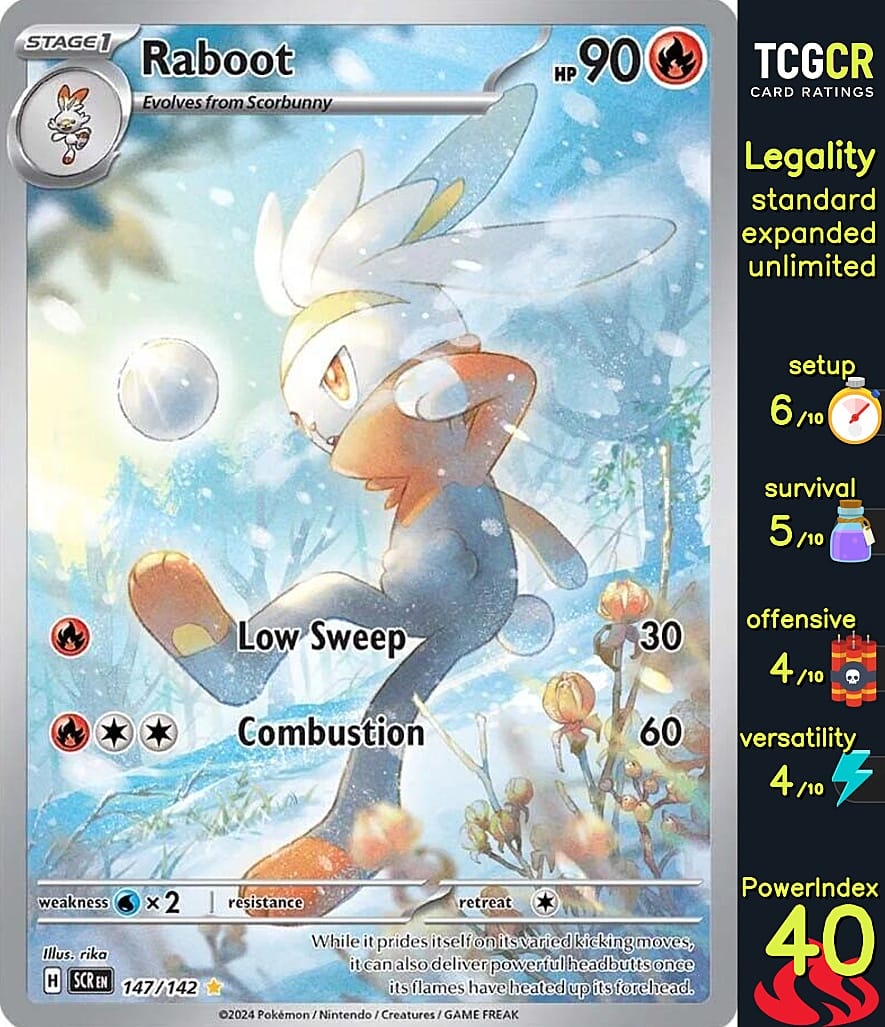
CARD INFORMATION
- SUBTYPES:
- Stage 1
- HP: 90
- TYPES:
- Fire
- EVOLVES FROM: Scorbunny
- EVOLVES TO:
- Cinderace
- WEAKNESSES:
- TYPE: Water
- VALUE: ×2
- RETREATCOST:
- Colorless
- RETREAT COST: 1
- RARITY: Illustration Rare
- REGULATIONMARK: H
CARD ABILITIES
This card has no abilitiesCARD ATTACKS
- NAME: Low Sweep
- COST:
- Fire
- ENERGY COST: 1
- DAMAGE: 30
- DETAILS:
- NAME: Combustion
- COST:
- Fire
- Colorless
- Colorless
- ENERGY COST: 3
- DAMAGE: 60
- DETAILS:
MARKET PRICES FOR RABOOT 💰
Last updated: 2025/11/21| HIGH | 29.00 | USD | |
| MID | 4.10 | USD | TREND |
| LOW | 3.02 | USD |
Check the latest prices on:
(link)
(link)
(link)
Raboot enters the TCG arena as a bridge between Scorbunny and Cinderace, offering trainers a Fire-type Stage 1 evolution option with moderate HP and attack potential.
As the middle evolution in this popular starter line, Raboot serves a transitional role but presents some interesting tactical considerations for Fire-type enthusiasts looking to build competitive decks with Cinderace as their end goal.
 Offensive rating: 4/10
Raboot's offensive capabilities are rather modest by competitive standards.
Its Low Sweep attack delivers 30 damage for a single Fire energy, providing a reasonable damage-to-energy ratio but lacking any additional effects.
Combustion requires a hefty investment of three energy (one Fire and two Colorless) to deal just 60 damage with no secondary effects.
This damage output falls significantly short compared to other Stage 1 Pokémon at similar energy costs.
The lack of any damage modifiers, opponent disruption, or self-buffing effects severely limits Raboot's offensive ceiling.
While Low Sweep can be useful in early game situations, Combustion rarely justifies its energy commitment in competitive play.
 Survival rating: 5/10
With 90 HP, Raboot sits in a vulnerable position for a Stage 1 Pokémon.
This health pool makes it susceptible to one-hit knockouts from many common attackers in the competitive landscape.
Its Water weakness is particularly problematic in metagames where Water-type attackers are prevalent, effectively reducing its functional HP to 45 against these opponents.
The single Colorless retreat cost is Raboot's saving grace in terms of survival, offering flexibility to switch out when threatened.
However, Raboot lacks any built-in defensive abilities or mechanisms to reduce damage, heal itself, or avoid attacks.
This combination of moderate HP, exploitable weakness, and absence of protective features makes Raboot quite fragile on the battlefield.
 Versatility rating: 4/10
Raboot's versatility is limited by its straightforward attack options and lack of special abilities.
As a Stage 1 Pokémon in the Scorbunny evolutionary line, its primary function is to serve as a stepping stone toward Cinderace.
While its single-energy Low Sweep attack provides some early game utility, Raboot struggles to fulfill multiple roles effectively.
It cannot function as a consistent main attacker due to low damage output, nor does it offer support capabilities for teammates.
Its only strategic flexibility comes from its reasonable retreat cost, allowing it to pivot to other Pokémon when needed.
In most competitive scenarios, players will aim to evolve Raboot into Cinderace as quickly as possible rather than utilizing it as a standalone card.
 Speed/Setup rating: 6/10
Raboot requires minimal setup for its basic functionality but offers little payoff for that investment.
Low Sweep can be powered up in a single turn with just one Fire energy attachment, making it immediately operational in that regard.
However, its more powerful Combustion attack demands three energy, typically requiring multiple turns or energy acceleration support to reach full potential.
As a Stage 1 Pokémon, Raboot also needs a turn to evolve from Scorbunny, further slowing its battlefield impact.
The lack of any abilities that would help accelerate its own evolution line or energy attachment rates means Raboot does little to improve its own setup efficiency.
Most competitive decks would aim to transition through Raboot as quickly as possible rather than building around it.
To maximize Raboot's effectiveness, it should be included in decks focused on rapidly evolving to Cinderace.
Energy acceleration cards are crucial to power up attacks more efficiently, while evolution support can help speed through the evolutionary line.
Cards that provide protection or healing can help compensate for Raboot's survival weaknesses during the transitional phase.
Perfect Partners examples:
Rare Candy
Bypasses Raboot entirely by evolving Scorbunny directly to Cinderace, reducing the vulnerability window of having Raboot in play while still allowing you to include it in your deck for situations where Rare Candy isn't available.
Welder
Provides crucial energy acceleration by attaching two Fire energy from your hand and drawing three cards, potentially enabling Raboot's Combustion attack in a single turn rather than waiting multiple turns.
Cinderace VMAX
As Raboot's final evolution, Cinderace VMAX offers a powerful endgame with significantly better attacks and HP, making the Raboot transition phase worthwhile despite its limitations.
Raboot functions primarily as a necessary evolutionary stepping stone rather than a standout competitive card.
Its modest 90 HP, straightforward attacks, and lack of special abilities position it as a transitional piece in Cinderace-focused strategies.
The single-energy Low Sweep provides some early utility, but the three-energy Combustion rarely justifies its cost.
With a reasonable retreat cost and manageable evolution requirements, Raboot isn't actively detrimental to your strategy, but it doesn't enhance it significantly either.
In tournament play, successful implementation involves minimizing Raboot's time on the battlefield—either through rapid evolution to Cinderace or bypassing it entirely with Rare Candy when possible.
Fire-type decks should include energy acceleration and protective support cards to compensate for Raboot's limitations during the evolution process, ensuring this middle-stage Pokémon doesn't become a liability in your carefully constructed competitive deck.
POWER INDEX
 | 40 |

 Our free website is made possible by displaying online advertisements to our visitors.