CARD INFORMATION
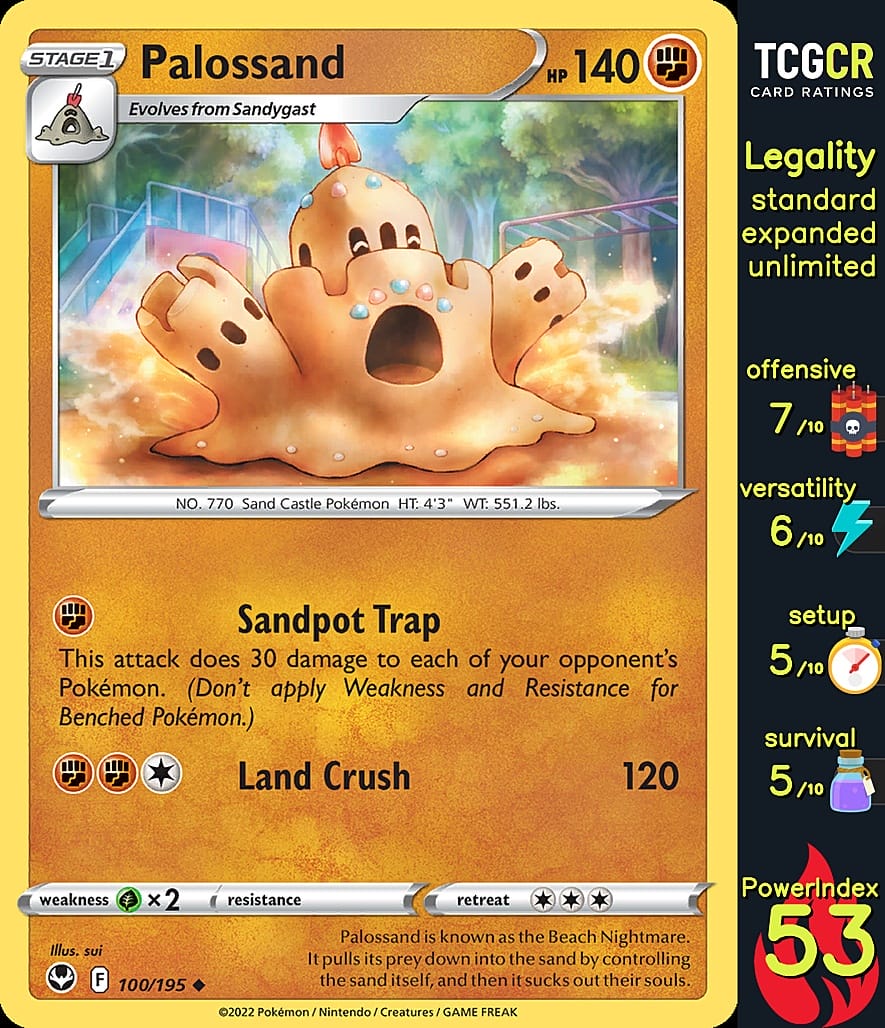
- SUBTYPES:
- Stage 1
- HP: 140
- TYPES:
- Fighting
- EVOLVES FROM: Sandygast
- WEAKNESSES:
- TYPE: Grass
- VALUE: ×2
- RETREATCOST:
- Colorless
- Colorless
- Colorless
- RETREAT COST: 3
- RARITY: Uncommon
- FLAVOR TEXT: Palossand is known as the Beach Nightmare. It pulls its prey down into the sand by controlling the sand itself, and then it sucks out their souls.
- REGULATIONMARK: F
CARD ABILITIES
This card has no abilitiesCARD ATTACKS
- NAME: Sandpot Trap
- COST:
- Fighting
- ENERGY COST: 1
- DAMAGE:
- DETAILS: This attack does 30 damage to each of your opponent's Pokémon. (Don't apply Weakness and Resistance for Benched Pokémon.)
- NAME: Land Crush
- COST:
- Fighting
- Fighting
- Colorless
- ENERGY COST: 3
- DAMAGE: 120
- DETAILS:
MARKET PRICES FOR PALOSSAND 💰
Last updated: 2026/01/16| HIGH | 19.98 | USD | |
| MID | 0.10 | USD | TREND |
| LOW | 0.03 | USD |
Check the latest prices on:
(link)
(link)
(link)
Palossand emerges from the Silver Tempest set as a Fighting-type Stage 1 Pokémon that combines area damage with single-target power.
With its ability to strike all opposing Pokémon simultaneously and follow up with considerable direct damage, this sandy specter deserves a close examination for players looking to apply widespread pressure while maintaining knockout potential.
 Offensive rating: 7/10
Palossand's offensive capabilities center around its dual attack options.
Sandpot Trap delivers 30 damage to each of your opponent's Pokémon for just one Fighting energy, creating excellent value across the board, especially against decks relying on multiple low-HP Benched Pokémon.
This spread attack doesn't apply Weakness, limiting its immediate knockout potential, but sets up multiple targets for future elimination.
Land Crush provides a straightforward 120 damage for three energy, which becomes 240 against Grass-weak Pokémon.
While this damage output isn't groundbreaking by current standards, the combination of spread damage and focused attacks allows Palossand to pressure opponents on multiple fronts.
Its damage-to-energy ratio is decent but not exceptional.
 Survival rating: 5/10
With 140 HP, Palossand sits in the middle range for Stage 1 Pokémon, making it neither particularly durable nor fragile.
Its x2 Grass weakness is problematic in certain matchups, especially against popular Grass attackers that can one-shot it with ease.
The heavy retreat cost of three is a significant liability, potentially trapping Palossand in the active position when you'd prefer to switch.
Without any built-in defensive abilities or HP-recovery mechanisms, Palossand relies entirely on its base stats for survival.
Players will need to incorporate Switch cards or other retreat solutions to maintain mobility, as getting stuck active after using Sandpot Trap can leave Palossand vulnerable to counterattacks.
 Versatility rating: 6/10
Palossand's versatility stems primarily from its ability to address both wide and tall board states.
Against decks with multiple Benched Pokémon, Sandpot Trap applies consistent pressure and can eliminate support Pokémon over time.
Against single-target strategies, Land Crush provides respectable damage output.
However, Palossand lacks the versatility of cards with built-in draw power, energy acceleration, or utility effects that would allow it to adapt to changing game states.
Its Fighting typing grants it favorable matchups against Dark, Lightning, and Fire Pokémon, but its overall effectiveness is matchup-dependent.
The card works best in specific deck archetypes rather than being a universally strong inclusion, limiting its versatility across the competitive landscape.
 Speed/Setup rating: 5/10
As a Stage 1 Pokémon, Palossand requires finding and evolving from Sandygast, adding a layer of setup complexity.
The evolution requirement means you'll typically need at least two turns before Palossand hits the field.
Its Sandpot Trap attack requires minimal energy investment, allowing for quick activation once evolved, but the more powerful Land Crush needs three energy attachments, making it a multi-turn setup unless paired with energy acceleration.
Without built-in methods to accelerate its own evolution or energy attachment, Palossand depends on external support cards to reach full effectiveness.
This dependency on both evolution and multiple energy attachments for its stronger attack makes Palossand somewhat slow in the current fast-paced meta.
Palossand benefits tremendously from cards that accelerate Fighting energy attachment and support evolution consistency.
Pairing it with Pokémon that can amplify spread damage or exploit the chip damage from Sandpot Trap creates powerful synergies.
Tools that reduce retreat cost or provide switching options are essential to overcome its mobility limitations.
Perfect Partners examples:
Turbo Patch
This Item card accelerates Palossand's energy attachment, helping it reach Land Crush faster. It addresses one of Palossand's key limitations by reducing the turns needed to power up its stronger attack.
Roxanne
This Supporter helps disrupt opponents while searching for evolution pieces. It allows you to find Sandygast and Palossand while potentially limiting your opponent's options, creating time for your setup.
Radiant Hisuian Goodra
Its Heavy Bullet ability adds 20 damage to attacks against your opponent's Active Pokémon, boosting both Sandpot Trap's spread effect and Land Crush's direct damage, enhancing Palossand's offensive output significantly.
Palossand presents an interesting package combining spread damage and single-target attacks in the Fighting type.
Its strength lies in applying consistent pressure across the board while maintaining the ability to focus down specific threats.
However, it struggles with setup speed, survival challenges, and mobility issues due to high retreat costs.
To maximize Palossand's effectiveness, build around it with energy acceleration, evolution support, and switching options.
In the right deck, it can function as an effective complementary attacker rather than a primary win condition.
The card performs best in formats where bench damage accumulation matters and Fighting types have favorable matchups.
While not a format-defining powerhouse, Palossand offers tactical flexibility that rewards strategic planning and board state awareness.
Players looking to incorporate it should focus on creating synergies that enhance its spread damage potential while mitigating its setup requirements.
POWER INDEX
 | 53 |




 Our free website is made possible by displaying online advertisements to our visitors.