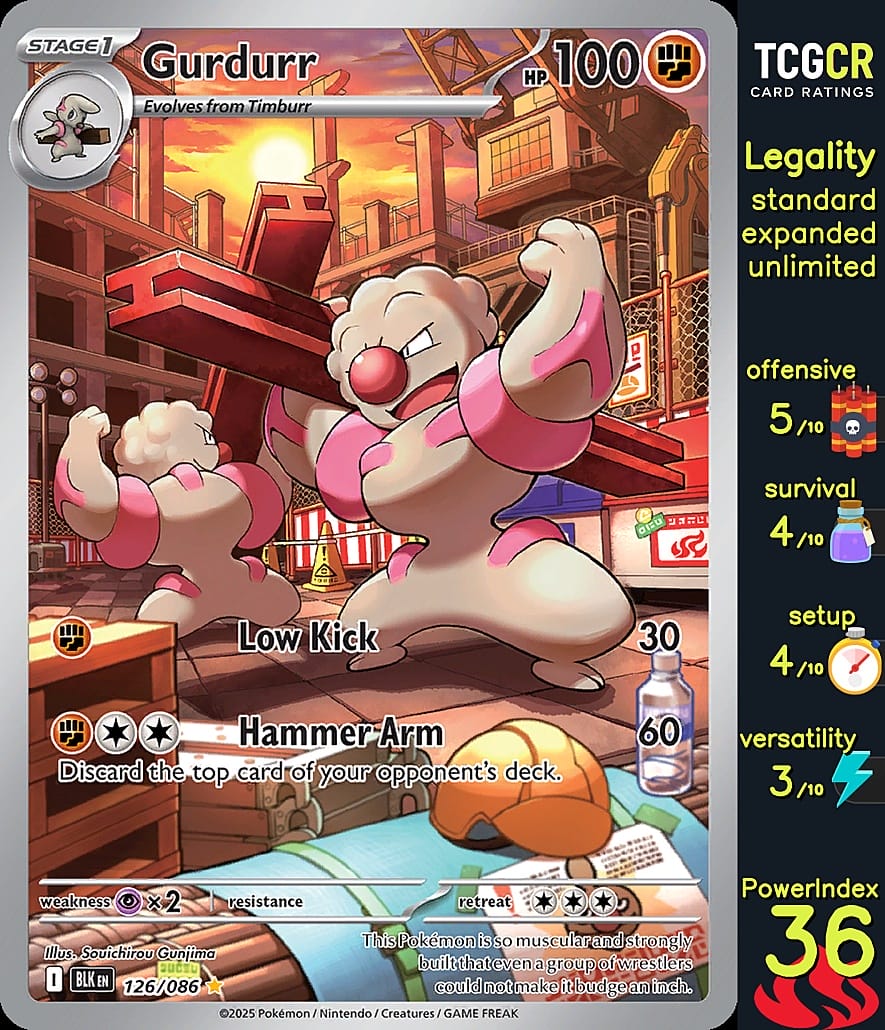
CARD INFORMATION
- SUBTYPES:
- Stage 1
- HP: 100
- TYPES:
- Fighting
- EVOLVES FROM: Timburr
- EVOLVES TO:
- Conkeldurr
- WEAKNESSES:
- TYPE: Psychic
- VALUE: ×2
- RETREATCOST:
- Colorless
- Colorless
- Colorless
- RETREAT COST: 3
- RARITY: Illustration Rare
- FLAVOR TEXT: This Pokémon is so muscular and strongly built that even a group of wrestlers could not make it budge an inch.
- REGULATIONMARK: I
CARD ABILITIES
This card has no abilitiesCARD ATTACKS
- NAME: Low Kick
- COST:
- Fighting
- ENERGY COST: 1
- DAMAGE: 30
- DETAILS:
- NAME: Hammer Arm
- COST:
- Fighting
- Colorless
- Colorless
- ENERGY COST: 3
- DAMAGE: 60
- DETAILS: Discard the top card of your opponent's deck.
MARKET PRICES FOR GURDURR 💰
Last updated: 2025/11/21| HIGH | 69.90 | USD | |
| MID | 4.74 | USD | TREND |
| LOW | 4.72 | USD |
Check the latest prices on:
(link)
(link)
(link)
Gurdurr storms onto the battlefield as a Fighting-type Stage 1 Pokémon with raw muscular power and intimidating presence.
Standing between its pre-evolution Timburr and final form Conkeldurr, this construction worker Pokémon brings modest damage output alongside an interesting mill mechanic that could disrupt your opponents plans.
 Offensive rating: 5/10
Gurdurr offers two straightforward attack options with moderate impact.
Low Kick delivers 30 damage for a single Fighting energy, providing decent energy efficiency in the early game.
Its main attack, Hammer Arm, deals 60 damage for three energy (one Fighting, two Colorless), which translates to a mediocre damage-to-energy ratio.
The added effect of discarding the top card of your opponents deck introduces a mild disruption element, but its impact is minimal and unreliable.
Without any damage modifiers or scaling mechanics, Gurdurrs offensive capabilities remain strictly average, lacking the punch needed to threaten most modern competitive threats effectively.
 Survival rating: 4/10
With 100 HP, Gurdurr sits at a mediocre survival threshold for a Stage 1 Pokémon.
This health pool leaves it vulnerable to being knocked out by most established attackers in a single hit.
Its Fighting typing gives it no notable resistances, while carrying a crippling Psychic weakness that further compromises its survivability against popular Psychic attackers.
The hefty three-energy retreat cost significantly hampers its mobility, forcing you to dedicate resources to switching strategies or accept significant tempo loss when retreating.
Without any built-in defensive abilities or healing mechanisms, Gurdurr remains highly vulnerable on the battlefield.
 Versatility rating: 3/10
Gurdurrs versatility is severely limited by its straightforward and underwhelming attack options.
The card lacks any abilities, bench support, or utility effects that would allow it to fill multiple roles in a competitive deck.
Its mill effect from Hammer Arm is too inconsistent to build a strategy around, discarding just one card at a time.
The Fighting-type damage can be relevant against certain Dark and Normal types, but numerous more efficient Fighting attackers exist.
As an evolution card, it requires additional deck space for its pre-evolution, further reducing flexibility.
Gurdurr struggles to find a distinct competitive niche beyond being a stepping stone to Conkeldurr.
 Speed/Setup rating: 4/10
As a Stage 1 Pokémon, Gurdurr requires evolving from Timburr, adding an inherent setup complexity.
Its energy requirements further slow its battlefield impact - Low Kick needs one turn of attachment to activate, while Hammer Arm demands three energy investments, typically requiring at least two turns of manual attachments.
The heavy retreat cost also counts against its setup efficiency, as youll need to consider switching cards or retreat costs in your strategy.
Without any special abilities or effects to accelerate its own setup, Gurdurr operates at a decidedly methodical pace that struggles to keep up with the rapid tempo of modern competitive play.
To maximize Gurdurrs limited potential, pair it with energy acceleration cards to power up Hammer Arm faster.
Consider Fighting support Pokémon to boost its modest damage output.
Mill strategy enablers can complement its discard effect, while switching cards help overcome its steep retreat cost.
Perfect Partners examples:
Rillaboom
Energy acceleration options like Rillaboom with its Voltage Beat ability can help attach multiple energies per turn, significantly reducing the setup time for Hammer Arms three-energy cost.
Diancie Prism Star
Diancie Prism Star provides a crucial +20 damage boost to your Fighting Pokémons attacks, elevating Gurdurrs damage output to more respectable levels against competitive threats.
Switch
Switch cards are essential companions for Gurdurr due to its prohibitive three-energy retreat cost, allowing you to pivot away from unfavorable matchups without sacrificing valuable energy attachments.
Gurdurr ultimately falls short of competitive viability in the current TCG landscape, hampered by mediocre damage output, subpar survivability, and slow setup speed.
Its mill effect on Hammer Arm presents an interesting concept but lacks the consistency and impact to build a strategy around.
The card primarily serves as a transitional piece toward its evolution, Conkeldurr, rather than a standalone threat.
In casual play, Gurdurr can find some success in Fighting-focused decks with ample energy acceleration and supporting cards to boost its damage output.
However, tournament players will find better options among the extensive roster of Fighting-type attackers with stronger damage-to-energy ratios and more impactful secondary effects.
If youre determined to use Gurdurr, focus on accelerating to its evolution or pairing it with cards that enhance Fighting-type damage to overcome its inherent limitations.
POWER INDEX
 | 36 |




 Our free website is made possible by displaying online advertisements to our visitors.