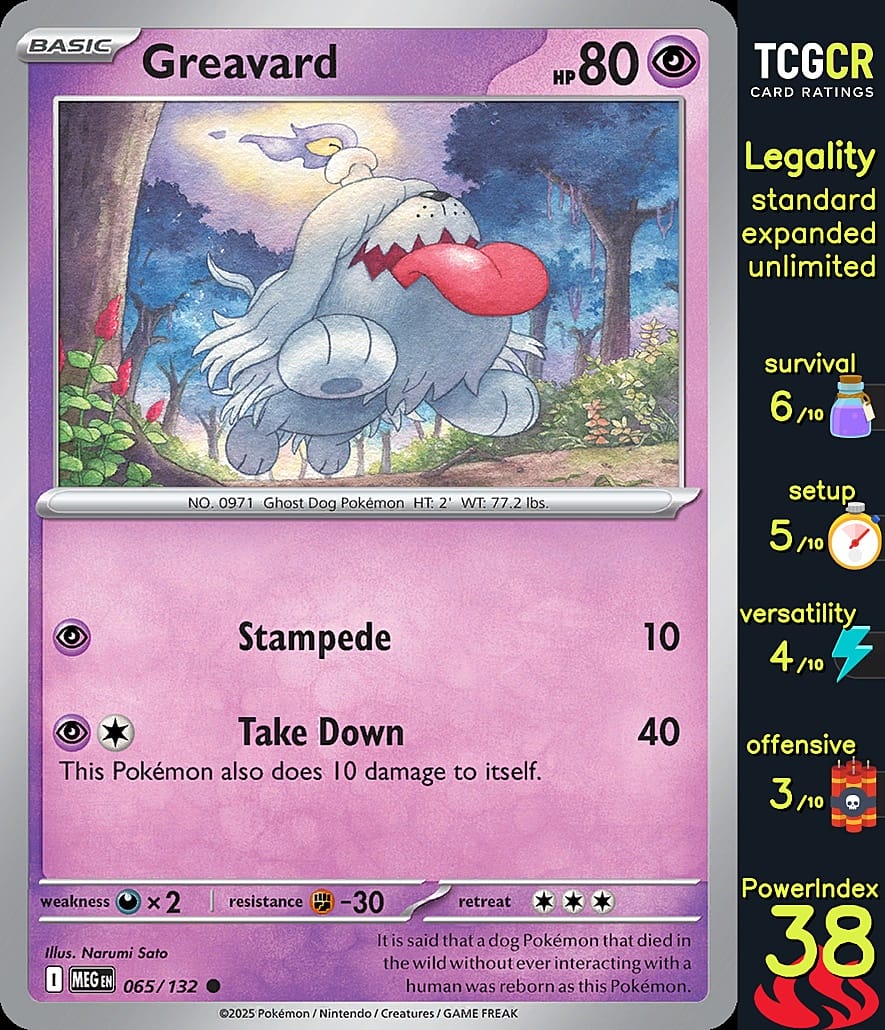
CARD INFORMATION
- SUBTYPES:
- Basic
- HP: 80
- TYPES:
- Psychic
- WEAKNESSES:
- TYPE: Darkness
- VALUE: ×2
- RESISTANCES:
- TYPE: Fighting
- VALUE: -30
- RETREATCOST:
- Colorless
- Colorless
- Colorless
- RETREAT COST: 3
- RARITY: Common
- REGULATIONMARK: I
CARD ABILITIES
This card has no abilitiesCARD ATTACKS
- NAME: Stampede
- COST:
- Psychic
- ENERGY COST: 1
- DAMAGE: 10
- DETAILS:
- NAME: Take Down
- COST:
- Psychic
- Colorless
- ENERGY COST: 2
- DAMAGE: 40
- DETAILS: This Pokémon also does 10 damage to itself.
MARKET PRICES FOR GREAVARD 💰
Last updated: 2026/04/08| HIGH | 999.00 | USD | |
| MID | 0.15 | USD | TREND |
| LOW | 0.01 | USD |
Check the latest prices on:
(link)
(link)
(link)
Greavard makes its debut in the Mega Evolution set as a Basic Psychic-type with some interesting characteristics that might initially fly under the radar.
While not immediately impressive with its modest attacks, this ghostly pup offers unique defensive positioning and potential role-playing in specific deck strategies.
Let's dig deeper to uncover where this spectral canine fits in the current TCG landscape.
 Offensive rating: 3/10
Greavard brings a two-attack lineup with relatively low damage output.
Stampede costs a single Psychic energy and delivers a mere 10 damage without any additional effects, making it essentially a placeholder attack.
Take Down is marginally better, requiring two energy (one Psychic, one Colorless) to deal 40 damage, but comes with a 10 self-damage drawback.
This attack efficiency is poor at just 20 damage per energy with a penalty attached.
The lack of any damage-enhancing abilities, special conditions, or defensive bypassing effects severely limits Greavards offensive potential.
Even in optimal scenarios with damage boosting support, the base values are too low to make meaningful impacts against most competitive threats.
 Survival rating: 6/10
Despite its offensive shortcomings, Greavard shows surprising resilience.
With 80 HP as a Basic Pokémon, its durability is middling but not terrible.
The standout feature is its Fighting resistance (-30), which provides substantial protection against popular Fighting-type attackers.
This resistance effectively gives Greavard 110 HP against Fighting Pokémon, allowing it to potentially survive hits that would KO similar HP basics.
However, its Darkness weakness (×2) creates vulnerability against an increasingly common type in the meta.
The hefty three-energy retreat cost is problematic, making Greavard difficult to pivot away from without switch cards or abilities.
 Versatility rating: 4/10
Greavards versatility is limited by its constrained attack options and specific typing.
As a Psychic-type, it can leverage Psychic-specific support cards and potentially counter Fighting types through its resistance.
However, its offensive capabilities lack the punch needed for a primary attacker role.
Its best positioning would be as a tech card against Fighting-heavy metas or as an early-game staller while setting up more powerful Pokémon.
The card doesnt offer any utility abilities, draw power, or energy acceleration that would make it valuable in diverse situations.
Greavards inclusion in decks will almost always be highly situational rather than broadly applicable across multiple strategies.
 Speed/Setup rating: 5/10
Greavards setup speed is a mixed bag.
As a Basic Pokémon, it can be immediately played to the bench, avoiding evolution delays.
Its first attack needs only one Psychic energy, allowing it to attack on turn one with the right opening hand.
However, to access its stronger Take Down attack requires two energy attachments, typically meaning a two-turn setup without energy acceleration.
The self-damage from Take Down further complicates its longevity, creating a maintenance cost that consumes resources.
With no innate ability to accelerate its own setup or integrate smoothly into energy-efficient strategies, Greavard struggles to establish itself as a reliable performer in the rapid pace of modern matches.
Greavard benefits most from energy acceleration, retreat assistance, and damage modification.
Pairing with cards that provide free retreat or reduce retreat costs helps overcome its mobility issues.
Energy acceleration supporters or Pokémon can help it reach its Take Down attack faster, while damage modifiers can boost its underwhelming output to more respectable levels.
Perfect Partners examples:
Cresselia
Cresselia offers Psychic energy acceleration that can help Greavard reach its Take Down attack in a single turn rather than waiting for multiple attachments, significantly improving its setup speed.
Escape Rope
This Item card helps overcome Greavards hefty three-energy retreat cost, providing crucial mobility that allows you to pivot away from unfavorable matchups without stranding energy resources.
Choice Belt
Adding 30 damage to Greavards attacks against Basic Pokémon transforms Take Down from a mediocre 40 damage to a more respectable 70, helping it reach important damage breakpoints against popular threats.
Greavard occupies an awkward middle ground in the current TCG environment.
Its Fighting resistance gives it a defensive edge in specific matchups, but its limited offensive capabilities and high retreat cost hold it back from broader competitive viability.
The 80 HP provides reasonable staying power for a Basic, but self-damage from Take Down undermines this advantage.
Most successful Greavard strategies would position it as a temporary wall against Fighting attackers while setting up stronger Psychic-type threats, or as part of a specialized deck leveraging its unique attributes.
Players looking to incorporate Greavard should focus on pairing it with energy acceleration, retreat assistance, and damage modifiers to compensate for its inherent limitations.
While not a powerhouse by any measure, smart players can still find strategic value in this ghostly pup in the right metagame environment.
POWER INDEX
 | 38 |

 Our free website is made possible by displaying online advertisements to our visitors.