CARD INFORMATION
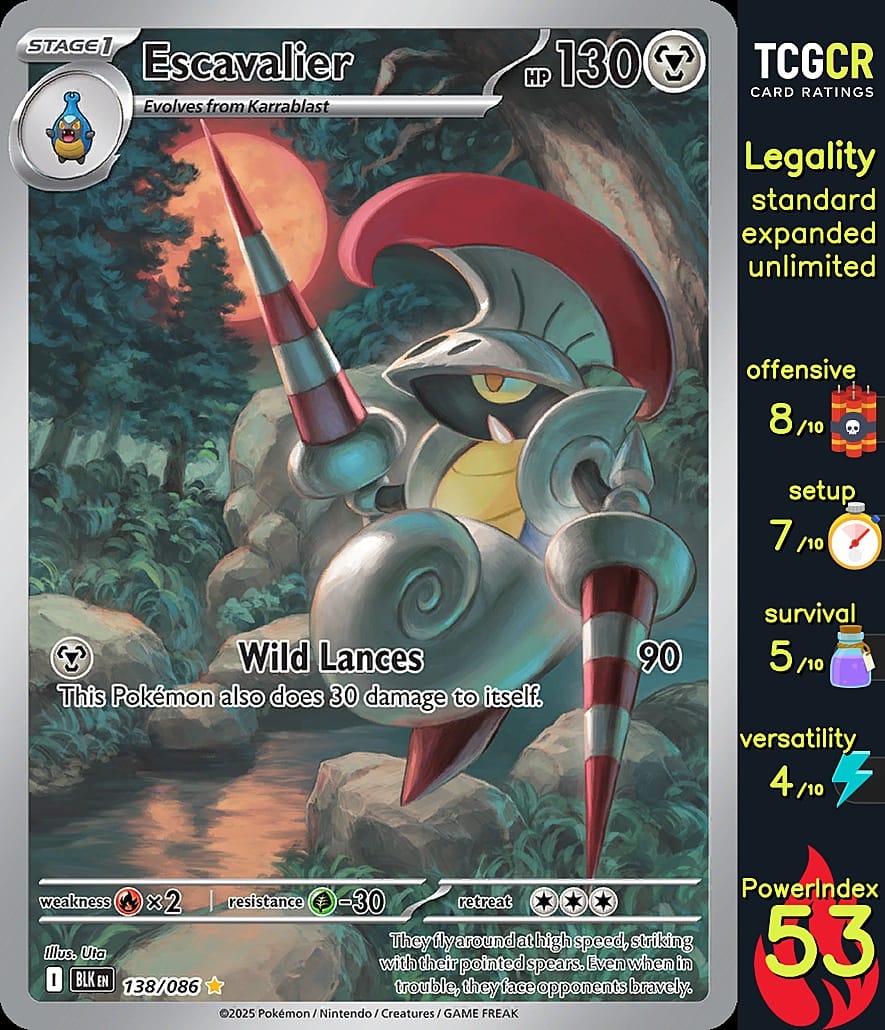
- SUBTYPES:
- Stage 1
- HP: 130
- TYPES:
- Metal
- EVOLVES FROM: Karrablast
- WEAKNESSES:
- TYPE: Fire
- VALUE: ×2
- RESISTANCES:
- TYPE: Grass
- VALUE: -30
- RETREATCOST:
- Colorless
- Colorless
- Colorless
- RETREAT COST: 3
- RARITY: Illustration Rare
- FLAVOR TEXT: They fly around at high speed, striking with their pointed spears. Even when in trouble, they face opponents bravely.
- REGULATIONMARK: I
CARD ABILITIES
This card has no abilitiesCARD ATTACKS
- NAME: Wild Lances
- COST:
- Metal
- ENERGY COST: 1
- DAMAGE: 90
- DETAILS: This Pokémon also does 30 damage to itself.
MARKET PRICES FOR ESCAVALIER 💰
Last updated: 2025/11/21| HIGH | 157.50 | USD | |
| MID | 9.91 | USD | TREND |
| LOW | 10.41 | USD |
Check the latest prices on:
(link)
(link)
(link)
Escavalier from the Black Bolt set brings medieval jousting to the Pokémon TCG battlefield.
This Metal-type Stage 1 evolution packs a surprising punch with minimal energy investment, though its self-damaging attack and hefty retreat cost require strategic consideration.
Let's analyze whether this armored knight has what it takes to charge through the competitive landscape.
 Offensive rating: 8/10
Escavalier's single attack, Wild Lances, delivers a respectable 90 damage for just one Metal energy.
This impressive damage-to-energy ratio puts it among the more efficient Basic attackers in the format.
At 90 damage per Metal energy, Escavalier can threaten KOs against many popular Basics and even some evolved Pokémon when factoring in weakness.
However, the 30 self-damage drawback significantly limits its sustained offensive pressure.
While Metal-type attacks benefit from favorable matchups against Fairy and Ice types in the current meta, the self-damage prevents Escavalier from maintaining consistent offensive momentum across multiple turns without support.
 Survival rating: 5/10
With 130 HP, Escavalier sits at a respectable but not impressive threshold for a Stage 1 Pokémon.
Its Grass resistance (-30) provides a meaningful buffer against popular Grass attackers, potentially allowing it to survive an extra attack in those matchups.
However, several critical factors undermine its survivability.
The Fire weakness (×2) leaves it extremely vulnerable in a meta where Fire-type attackers remain relevant.
The crippling three-energy retreat cost severely hampers mobility, potentially trapping Escavalier in unfavorable positions.
Most significantly, the 30 self-damage from Wild Lances means Escavalier damages itself with each attack, limiting it to at most four attacks before defeating itself.
 Versatility rating: 4/10
Escavalier suffers from limited versatility in the current competitive landscape.
With a single attack option, it lacks the flexibility to adapt to different situations or opponents.
While the Metal typing provides some strategic advantages against certain deck types (particularly against Fairy and Ice), its rigid attack pattern makes it predictable.
The self-damage mechanic further restricts its utility as a sustained attacker.
Its high retreat cost severely limits its ability to pivot in response to changing board states.
Escavalier could potentially find niche applications in specific Metal-focused archetypes or as a tech option against Grass-heavy lineups, but generally lacks the versatility needed for broad competitive viability.
 Speed/Setup rating: 7/10
As a Stage 1 Pokémon, Escavalier requires evolving from Karrablast, which adds a layer of setup complexity compared to Basic Pokémon.
However, once in play, its attack efficiency is impressive - requiring only one Metal energy to immediately start attacking at full power.
This minimal energy requirement is a significant advantage, allowing Escavalier to become operational by turn 2 in most cases.
Standard evolution-accelerating tools like Rare Candy won't work with Escavalier, but other evolution support cards can help bring it online more consistently.
The main setup challenge lies not in powering up Escavalier but in managing its high retreat cost and self-damage mechanic, which require additional support cards to address effectively.
Escavalier benefits tremendously from cards that mitigate its self-damage and mobility issues.
Metal-type support cards that provide damage reduction or healing effects are essential companions.
Switch cards or pivot Pokémon help overcome the prohibitive retreat cost, while energy acceleration supports can keep it powered through multiple retreats.
Consider pairing with Manaphy (for free retreat), Metal-type healers, or damage-modifier effects that can push Wild Lances into crucial KO thresholds.
Perfect Partners examples:
Manaphy
Provides free retreat capability to all your Pokémon, solving Escavaliers crippling 3-energy retreat cost and allowing it to pivot when facing unfavorable matchups without wasting resources.
Big Charm
Adds +30 HP to Escavalier, effectively negating one round of self-damage from Wild Lances and increasing overall durability, allowing it to potentially get off an additional attack before being knocked out.
Bronzong
With energy acceleration abilities, Bronzong can help reattach Metal energy to Escavalier after retreating, ensuring it stays powered up throughout the match despite mobility challenges.
Escavalier presents an intriguing package of high damage efficiency counterbalanced by significant drawbacks.
Its ability to output 90 damage for a single Metal energy is impressive, but the 30 self-damage, high retreat cost, and lack of attack variety severely limit its competitive potential.
To maximize Escavalier's effectiveness, focus on pairing it with cards that mitigate these weaknesses - healing effects to counter self-damage, switching options to overcome the retreat cost, and Metal support to amplify its strengths.
This armored knight works best as a specialized attacker in Metal-focused decks rather than as a centerpiece.
While not a top-tier contender, Escavalier can still deliver surprisingly effective results in the right deck construction, particularly in formats where its Grass resistance becomes relevant.
Consider it a specialized jouster rather than an all-purpose knight for your competitive lineup.
POWER INDEX
 | 53 |

 Our free website is made possible by displaying online advertisements to our visitors.