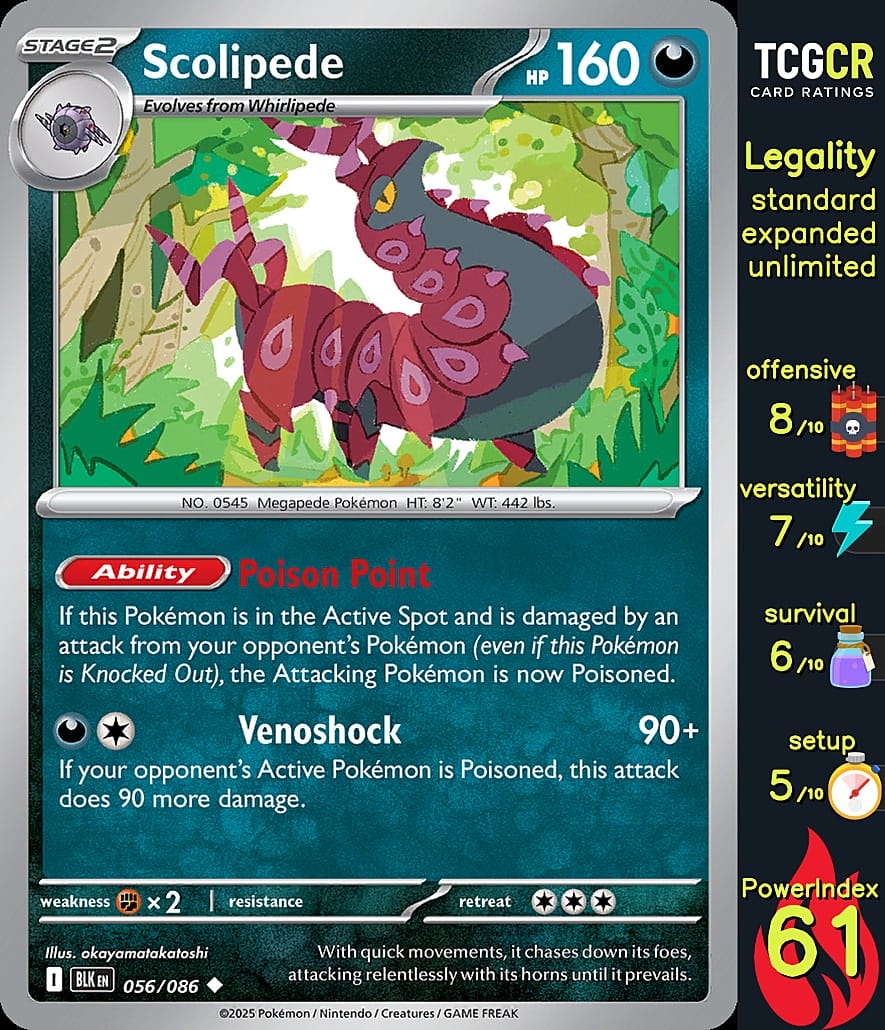
CARD INFORMATION
- SUBTYPES:
- Stage 2
- HP: 160
- TYPES:
- Darkness
- EVOLVES FROM: Whirlipede
- WEAKNESSES:
- TYPE: Fighting
- VALUE: ×2
- RETREATCOST:
- Colorless
- Colorless
- Colorless
- RETREAT COST: 3
- RARITY: Uncommon
- FLAVOR TEXT: With quick movements, it chases down its foes, attacking relentlessly with its horns until it prevails.
- REGULATIONMARK: I
CARD ABILITIES
- NAME: Poison Point
- DETAILS: If this Pokémon is in the Active Spot and is damaged by an attack from your opponent's Pokémon (even if this Pokémon is Knocked Out), the Attacking Pokémon is now Poisoned.
- TYPE: Ability
CARD ATTACKS
- NAME: Venoshock
- COST:
- Darkness
- Colorless
- ENERGY COST: 2
- DAMAGE: 90+
- DETAILS: If your opponent's Active Pokémon is Poisoned, this attack does 90 more damage.
MARKET PRICES FOR SCOLIPEDE 💰
Last updated: 2026/01/21| HIGH | 19.98 | USD | |
| MID | 0.10 | USD | TREND |
| LOW | 0.01 | USD |
Check the latest prices on:
(link)
(link)
(link)
Scolipede slithers into the competitive scene as a venomous threat that punishes opponents for daring to attack it.
This Stage 2 Darkness-type Pokémon combines defensive capabilities with poison-based offense, creating a unique dynamic that can catch unprepared opponents off guard.
Let's examine how this 160 HP bug can potentially crawl its way into your tournament deck.
 Offensive rating: 8/10
Scolipede's Venoshock attack delivers a respectable 90 damage for just two energy, offering solid energy efficiency.
Where it truly shines is against poisoned Pokémon, doubling its output to 180 damage—enough to threaten most Basic Pokémon and many evolved forms.
This synergy with its own Poison Point ability creates a powerful offensive loop: opponents attack Scolipede, become poisoned, then face amplified damage on your turn.
The attack requires minimal energy investment (just one Darkness and one Colorless), making it relatively easy to power up.
However, without poison in play, the damage output falls to merely average levels, and the attack lacks any secondary effects beyond conditional damage boosting.
 Survival rating: 6/10
With 160 HP, Scolipede sits in a solid middle ground for a Stage 2 Pokémon—durable enough to potentially survive a hit, but not exceptionally tanky.
Its Fighting weakness is problematic in metas where Fighting-types are prevalent, potentially turning 2HKOs into OHKOs.
The hefty three-energy retreat cost severely limits mobility, making it difficult to pivot without specific support cards.
Poison Point provides excellent passive value, automatically poisoning any Pokémon that damages Scolipede.
This ability activates even if Scolipede is knocked out, ensuring some retaliation value.
However, this defensive mechanism only inflicts a condition rather than reducing incoming damage directly, limiting its immediate protective value.
 Versatility rating: 7/10
Scolipede demonstrates reasonable versatility through its dual-functioning approach to poison.
It can serve as both a poison enabler through its ability and a poison punisher through its attack.
This allows it to fit into poison-themed decks in multiple roles.
It works independently without needing specific support Pokémon to function, though it benefits greatly from cards that can inflict poison status.
However, outside of poison-focused strategies, Scolipede's utility drops considerably.
The poison mechanic can be countered by opponents switching their active Pokémon or using status-clearing effects, and Scolipede lacks alternative attacking options if its poison synergy is disrupted.
Its energy needs are manageable but not especially flexible, limiting deck building options.
 Speed/Setup rating: 5/10
As a Stage 2 Pokémon, Scolipede faces significant setup challenges.
The evolution line requires dedicating deck space to Venipede (Basic) and Whirlipede (Stage 1) cards, increasing the risk of bricking or drawing incomplete evolution lines.
Players must navigate through two evolution steps, typically taking at least three turns without acceleration tools.
The 3-cost retreat further compounds setup issues, as a stranded pre-evolution in the active spot can be difficult to pivot away from.
On the positive side, once established, Scolipede needs minimal ongoing investment—just two energy to attack effectively.
The deck doesn't require complex board states beyond establishing poison conditions, making its operation straightforward after the initial setup hurdles are overcome.
Scolipede thrives in decks focused on poison strategies, benefiting from cards that can spread poison status effects and capitalize on poisoned opponents.
Support that reduces retreat cost or provides mobility is essential to overcome its heavy retreat requirement.
Energy acceleration for Darkness types helps bypass its evolution timeline limitations.
Perfect Partners examples:
Seviper
Cards like Seviper that enhance poison damage or provide additional ways to poison opponents synergize perfectly with Scolipede's Venoshock attack, turning moderate damage into significant threats without additional energy investment.
Escape Rope
This Item card helps overcome Scolipede's crippling three-energy retreat cost, providing crucial mobility when Scolipede needs to retreat without discarding attached energy, or when pre-evolutions get stuck in the active position.
Rare Candy
Accelerates Scolipede's setup by skipping the Stage 1 evolution, allowing players to evolve directly from Venipede to Scolipede and reducing the typical three-turn setup to just two turns.
Scolipede carves out a niche as a poison specialist that punishes opponents for engaging with it while amplifying return damage against poisoned targets.
The card creates a compelling risk/reward scenario for opponents: attack Scolipede and become poisoned, or avoid it and potentially give you time to set up.
Its most effective deployment comes in poison-centric builds where its 180 potential damage can be consistently realized.
However, significant evolution hurdles and mobility issues prevent it from being a top-tier threat in the current meta.
Players looking to maximize Scolipede should focus on accelerating its evolution, managing its retreat cost, and ensuring reliable poison application across multiple Pokémon.
In the right deck architecture with proper support, this venomous Stage 2 can deliver surprising value, particularly in matchups where opponents must repeatedly attack into your Pokémon to maintain board control.
POWER INDEX
 | 61 |






 Our free website is made possible by displaying online advertisements to our visitors.