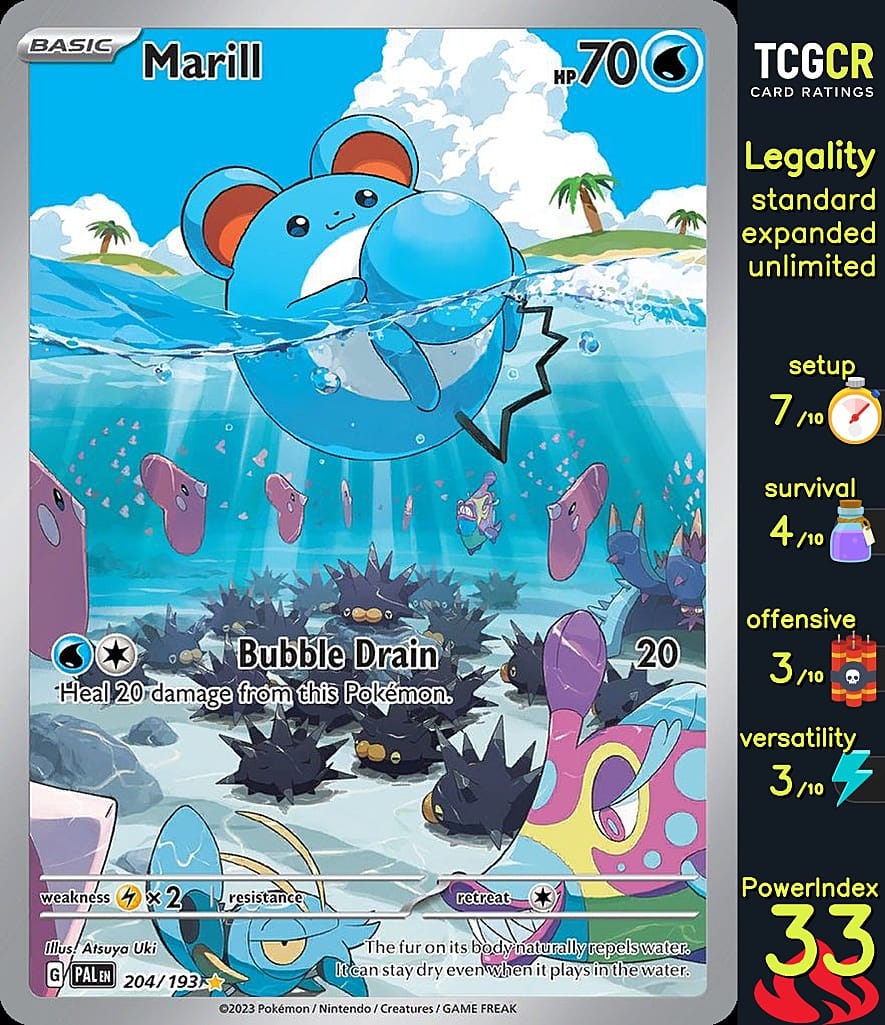
CARD INFORMATION
- SUBTYPES:
- Basic
- HP: 70
- TYPES:
- Water
- WEAKNESSES:
- TYPE: Lightning
- VALUE: ×2
- RETREATCOST:
- Colorless
- RETREAT COST: 1
- RARITY: Illustration Rare
- FLAVOR TEXT: The fur on its body naturally repels water. It can stay dry even when it plays in the water.
- REGULATIONMARK: G
CARD ABILITIES
This card has no abilitiesCARD ATTACKS
- COST:
- Water
- Colorless
- NAME: Bubble Drain
- DAMAGE: 20
- DETAILS: Heal 20 damage from this Pokémon.
- ENERGY COST: 2
MARKET PRICES FOR MARILL 💰
Last updated: 2025/11/18| HIGH | 96.95 | USD | |
| MID | 26.24 | USD | TREND |
| LOW | 22.50 | USD |
Check the latest prices on:
(link)
(link)
(link)
Marill enters the competitive scene as a modest Water-type Basic Pokémon with some self-sustaining capabilities.
This round blue mouse might not command immediate attention, but its Bubble Drain attack offers interesting defensive utility that deserves examination for budget Water decks or as an early-game transitional card.
 Offensive rating: 3/10
Marill's offensive capabilities are notably limited.
Bubble Drain deals a mere 20 damage for two energy (one Water, one Colorless), placing it well below the damage-to-energy ratio needed for competitive viability.
Even factoring in the healing effect, the attack's damage output remains insufficient to threaten even low-HP Basics effectively.
Against evolved Pokémon or V/VMAX cards, Marill barely makes a dent.
Without access to tools like Choice Belt to boost damage, and lacking any secondary effects like status conditions or damage placement, Marill struggles to provide meaningful offensive pressure in nearly all matchups.
 Survival rating: 4/10
With 70 HP, Marill sits in a dangerous range where it's easily knocked out by most developed attackers in the format.
Its Lightning weakness is particularly problematic in metas where Electric types are prevalent.
The single retreat cost is manageable but not exceptional.
Where Marill does gain survival points is through its Bubble Drain attack, which heals 20 damage - effectively extending its effective HP to 90 against multiple attacks.
This healing capability can occasionally allow Marill to survive an extra turn against chip damage or weaker attackers, but doesn't substantially change its vulnerability to most meta threats.
 Versatility rating: 3/10
Marill suffers from limited versatility in the competitive landscape.
As a Basic Water Pokémon, it can fit into Water-type strategies, but its contributions remain minimal compared to stronger alternatives.
The self-healing mechanic adds a minor defensive dimension, but this alone isn't enough to justify inclusion in serious competitive decks.
Marill doesn't function well as a tech card against specific matchups nor does it counter any particular strategies effectively.
The card lacks synergy with major archetypes and doesn't meaningfully contribute to ability-based strategies, evolution chains, or energy acceleration.
It could serve as a transitional piece in budget Water decks, but its overall versatility remains extremely constrained.
 Speed/Setup rating: 7/10
Marill's setup requirements are relatively minimal, which is one of its few advantages.
As a Basic Pokémon, it can be played directly to the bench and requires only two energy attachments to attack.
With standard Water energy acceleration tools like Frosmoth or Capacious Bucket, Marill can potentially attack by turn two.
The card doesn't require complex evolution chains or special conditions to function at its baseline level.
However, this simplicity comes with significant limitations - even when fully set up, Marill's impact remains marginal.
Its searchability is standard through conventional means like Quick Ball or Ultra Ball, but it doesn't offer any special access mechanics.
Marill benefits most from energy acceleration partners that can power up its attack quickly, damage boosting tools to increase its offensive output, and protective cards that leverage its self-healing capability to create a more resilient attacker.
Perfect Partners examples:
Frosmoth
Frosmoth's Shining Scales ability allows for rapid Water energy attachment, enabling Marill to attack consistently while overcoming its two-energy requirement limitation.
Choice Belt
Adding 30 damage to Marill's meager 20 damage output significantly improves its offensive potential, transforming Bubble Drain into a more respectable 50-damage healing attack.
Manaphy
Manaphy's Wave Veil ability protects Benched Water Pokémon, giving Marill time to develop while healing with Bubble Drain when called into the active position.
Marill represents a baseline Water-type attacker with limited competitive applications in the current meta.
Its greatest strengths lie in its simplicity as a Basic Pokémon and its self-healing capability, which can occasionally provide utility in budget builds or specific niche strategies.
However, the card's subpar damage output, mediocre HP, and lack of meaningful secondary effects severely restrict its viability in tournament play.
Players looking to leverage Marill should focus on energy acceleration and damage modification to maximize its potential, though even optimized builds will struggle against established archetypes.
As the competitive environment continues to evolve with higher HP totals and more efficient attackers, Marill unfortunately falls further behind the power curve, relegated primarily to casual play or as a transitional card while building toward stronger Water-type strategies.
POWER INDEX
 | 33 |

 Our free website is made possible by displaying online advertisements to our visitors.